Tuesday, 16 September 2014

friend...real connections, real stories

Real Connections: MEANING, STRUCTURE, RELATIVES, PRONUNCIATION
<friend> 
... such a valuable and interesting word to investigate at the beginning of the school year...
I love that this word has a non-phonemic letter to demonstrate that not all letters in an English word will represent pronunciation. 

I love that this word explicitly demonstrates that the primary function of English spelling is to represent MEANING, not pronunciation.

I have been working with a group of young students whose previous spelling instruction has primarily been based on thinking that spelling represents sound.

"Time to change their thinking by explicitly demonstrating and investigating 
how the English spelling system really works."

I want the children to be able to spell <friend> accurately from the very beginning of the school year but  more importantly I want them to know why it is spelled this way; I want them to understand that not all letters in a word are there to represent pronunciation; I want them to know that some letters are etymological markers which give us important clues about the spelling. I want the children to be on a learning journey of discovery and understanding...

How did I choose <friend> for investigation?
This was a central word as part of the initial discussion and development of the class essential learning agreements early in the school year, in conjunction with many others like: <respect> <safety> <collaboration>. All ripe for future word investigation and inquiry!

From the beginning of the school year the children were consistently challenged to think about the how and why of words. We constructed many word families using words from the first PYP Unit of Inquiry. They were introduced to important terminology; base, suffix, prefix, meaning, structure.
After only one month the children are already  beginning  to analyse/synthesise words based on this growing understanding.

Setting the scene
We presented two questions:
 I deliberately used the terminology 'word' not 'base' in this
question so that the children would consider another
possible base.
Initially I chose to present <friend> as
the base but  I also presented this question
to provoke and challenge the children's thinking.
I wanted to see if anyone would
 hypothesise <fri> as a possible base.

1. What does it mean? Predictably the children discussed the idea of 'friendship' connected to their personal experiences.
2. What is the structure of the word? The majority of the children hypothesised  <friend> as the base. Predictably one child presented <fri> (as in <fry>)  which led to an important discussion about meaning and how <fry> has no meaning connection to <friend>. 

Consistently, I observe children needing this fundamental concept to be revisited over and over again to help them fully understand the importance of both meaning and structure as the key to the connection.
3. What are its relatives?
The first activity was a think/pair/share. Individually, the children wrote one or two (or more) words related to the word <friend> on a piece of paper. This was an initial assessment piece to ascertain the children's present understanding of how words are related in meaning and structure. The children then collected further words, to add to their original list, by sharing with each other. They moved from partner to partner until they had collected an extended list. It was incredibly exciting to watch the children actively discussing and trading each other's words. 
The children are writing a collection of words
related to <friend>

The children shared their hypotheses with each other and
added to or modified  their own list of  words.
I had the absolute joy of overhearing one student tell another student (who offered <fri> and <end> as  two related words) that they couldn't belong in the family of <friend> "because they didn't have the same meaning or the same spelling."  He then proceeded to give the other student clear evidence by providing his three words (friendly, friends and befriended) to demonstrate what he meant. No need for adult intervention here...Max had certainly provided the necessary teaching. I shared this observation later  as we revisited the fundamental concept of  how words are related in meaning and structure.

Can you see how valuable this initial activity is in terms of assessing children's understanding throughout the learning process? 
The other valuable part of this activity is the expectation that all children will actively participate, regardless of where they are on their learning pathway; and the opportunity to learn from each other, as demonstrated above, cannot be underestimated. 
A student is extending her list of
related words by trading with her
classmates.

As a whole group, we shared and recorded the words on a word web. I explicitly stated, every time, how the words were related in meaning and structure; and how new words were constructed. 

What did you do to construct this word <friendly>? 
...consistently asking the students to clarify and provide evidence...
How do you know <-ly> is a suffix?

The word bag!
A student, who currently speaks very little English, had the job of extracting words from a word bag, to check if there were others we could add to the current word web. I placed two words for provocation  in the bag: <fried> and <Friday>.  The children suggested that both <fried> and <Friday> couldn't belong in this word family because they didn't have the same meaning. We decided to leave these words off the word web until we had provided some evidence. You will notice that even though I knew, as a teacher, that <Friday> was related, that I didn't share this information at this particular time on their learning journey. My goal was to guide them to their own understanding of this relationship.

However, I did ask the question "I wonder what Friday means?" to challenge their thinking and hopefully jog their previous learning about the days of the week. One student suggested that Friday was named after Frigga! "I know her!" counteracted many of the other children.

An Etymological Study!
As I told the historical 'story" I wrote key words,
pictures and connecting arrows to demonstrate
the 'big picture'.
The children also recorded the story
on individual whiteboards.
The following day I related the historical 'story' of 'friend' by linking the word to 'Friday' and 'Frigga'.  
We studied images of the Romans and the Germanic peoples, explaining how the days of the week evolved through history. The children could clearly see the connection between Friday and Frigga.

I modelled how to use the Word Origin Dictionary to discover further important historical information about 'friend'. For many this was new.
<friend> was written on a post-it note to indicate where in the dictionary it was located. A child was selected to open to the page and locate the word <friend>. 
I summarised the relevant information highlighting the diachronic meaning; 'loving' Old English 'freond'; Proto Germanic 'frijand'.
The children were now able to ascertain a clearer connection with 'Friday' and 'Frigga'. 
The <i> is present to show its meaning connection to <Friday> and historical connection to 'Frigga', the Germanic Goddess of love.
The children are recording the history
of <friend> as we discuss it together.
Of course this is not the full etymological story of the word <friend>. You can trace its history way back from the PIE root 'pri' meaning 'to love'. One student has recently discovered that <free> is related too!

A closer investigation of the structure of words and the 'spelling out' strategy
In subsequent lessons we investigated the structure of each of the words from the word web. Beginning with a blank matrix we gradually added the appropriate affixes to construct new words. 
I explicitly modelled the construction of the word sum, demonstrating the 'spelling out' strategy, critical for internalisation. The children practised constructing the word sums on individual whiteboards.
                                   
I briefly introduced how to identify and check for any changes.  "Stop, check for changes, change the y to an i" as in this word structure: <friend> + < ly/i> + <er> --> friendlier
For now, I only needed the children to understand that there might be a change caused by a suffix. Investigation                                                                        of the <i/y> suffixing convention would happen in the                                                                            future.


During the next few days we constructed additional words, writing the word sum to demonstrate the underlying structures. You may notice that the matrix is not completed and it won't be for sometime. This 'work in progress' is an indication of the children's learning journey; an understanding that we could add, change, modify the matrix and word web as our learning deepens. 
More information is gradually
added to the matrix as we revisit
meaning, structure, history
and connections.
Throughout the process one student consistently wanted to know how could we add <Friday> to the matrix. He had developed a hypothesis that <fri> was the base, based on the structure of <Friday> Fri + day --> Friday
I had this blank matrix ready to demonstrate his hypothesis. We will revisit this matrix and discuss how it could be constructed at another time. It is there for provocation, thought and discussion. 

Time to consolidate
The following week the children  independently constructed word sums from a variety of matrices.  
I can assure you by this stage all the children are spelling <friend> accurately and they know why there is an <i>! 
You will notice that the matrices are different, varying in complexity. At times I choose the matrices for the children, other times they choose. One student added to the complexity of his matrix, demonstrating his own deep understanding of the underlying structures of words.  
The children chose words to write in sentences or illustrate to show the meaning; they constructed words at home to teach their families.
 

We have been revisiting the structure of words by constructing large word sums to identify the morphemes and graphemes in the base and the underlying changes.
In this session the children had one piece of the word sum, on a large piece of card.
Together they had to sequence themselves to form the final word sum. Collaboration in action.
This beats memorising a list of unrelated words!
What about pronunciation?
Throughout the whole learning process the children were introduced to 'tasting and feeling' phonemes. We have started to look more carefully at what is happening in our mouth and throat as we sequence the important phonemes in a word. 

Learning is a journey; a journey of discovery and connections...and so our journey continues!

You can go to Real Spelling, Toolkit2 Kit2 ThemeL Naming the Days of the Week, for the full story of <friend>.

and Pete Bowers Word Works Spelling Out Word Structure
Give me a shout! 
If you happen to be using my blog please drop me a line and let me know what you think, 
what you would like to see, what you enjoyed! 

Wednesday, 23 April 2014

Teaching Orthography in the Early Years: word webs for young children

The primary function of English spelling is to represent MEANING. 
Implementing orthography, 
through scientific inquiry, in the early years. 

As I continue on my learning journey, and work with young children in a variety of learning settings, it is consistently validated that teaching morphology to the youngest is not only essential but critical to their success as proficient language users.  

As we know and understand from research, morphology is the building block, the solid foundation, for understanding how the English spelling system works. It provides a meaningful structure for teaching and learning phonology in an effective and authentic way.

In this post, I would like to share a wonderful learning story of a group of young children who are currently embarking on a journey of orthographic understanding.

This structured word inquiry was explicitly embedded in an authentic literacy learning experience, integrating all forms of language.

Throughout the learning experience the children clearly demonstrated their deep understanding of how words are connected in meaning and structure. 


We started this particular learning journey by rereading a well loved story, Mrs Wishy Washy by Joy Cowley.The children were delighted to read the story to me, which they did with great enthusiasm and understanding.They clearly viewed themselves as proficient readers, by explaining and discussing the underlying ideas and meaning of the story. 

I shared my favourite part of the story, by writing a sentence to demonstrate and model my thought processes, emphasising the word <jumped>. Hence, the starter base for this investigation is <jump>.

The cow jumped in the mud. 

I have also observed  a teacher of another prep class require the children to draw their thinking about the starter base before embarking on the word family activity. A very valuable, authentic assessment of children's understanding and learning!

Concept attainment:
We then dived into the 'bag of words' and pulled out the word    <jumped>, written on a large chart. 
             jumped
"Jumped," shouted the children with glee. 

By ensuring the children had meaningfully encountered this word in a reading and writing context all the children were able to make true sense of the word. 

I modelled how to announce the spelling of <j-u-m-p-ed> by spelling aloud the single letter graphemes and the suffix. This word was placed inside a hoop. The children orally shared their understanding of the meaning of the word through their own life experiences. 

The bag of words also contained <jumped> <jumping> <jumper> <jumps> as well as two others <rolled> and <paddled>.

We then proceeded to pull out further words making decisions together if the word belonged inside the hoop or outside the hoop. Each time we viewed a word I announced the morphemes and graphemes. 

In pairs, the children discussed the words inside the hoop and then shared their hypotheses of why <jumped> <jumping> <jumps> and <jumper> belonged to the same morphological word family but <rolled> and <paddled> did not. The children did this with exceptional focus and interest.


The children recorded their thinking by illustrating the meaning of the words in the hoop. As the children were writing their chosen word, this created further opportunities to model the spelling out strategy.

After recording their thinking the children created a word web to record how the words are linked in meaning and structure. 


Again I announced the morphemes and graphemes, reinforcing new terminology and concepts. The children decided they needed to construct additional word webs for <rolled> and <paddled> and I have no doubt that they could accomplish this effectively through a similar inquiry investigation.


Every time I share this activity with children it confirms, consolidates and ratifies the utmost importance of implementing morphology in the early years. Right from the very beginning young children need to fully understand that the primary function of English spelling is meaning.

Now, let's think about the phonological connections 
that are explicitly embedded in this activity.

During this particular SWI lesson the children are consistently revisiting and consolidating the names of 4 alphabet letters 
<j> <u> <m> and <p> 

They are implicitly introduced to four single letter graphemes 
<j-u-m-p>

and the phonemes these graphemes are representing in the base word <jump>
/dÊ’/ /u/ /m/ /p/

In the following weeks you could choose another starter base, like <play> and highlight the circumstances of the single letter grapheme <p> in this base word and compare it to the circumstance of the single letter grapheme <p> in <jump>.

The children can investigate and discuss if <p> represents the same or a different phoneme when the <p> is in the initial and final positions of these two base words.

<play> presents a meaningful introduction to the digraph <ay>, a team of letters working together to represent the phoneme long /a/, in the final position.

Additionally, this would naturally lead into an introduction of the six vowel letters, and an investigation, of the importance of these letters in understanding the spelling of a base. Please refer to the blog post The Power of Kinaesthetic Learning for further information regarding the teaching of vowels.

In just one lesson the children have been meaningfully introduced to a variety of important morphological and phonological 
concepts and terminology. 

Thursday, 6 February 2014

An Exceptional Learning Tool: The Flowchart


Constructing learning using a powerful learning tool, to engage and empower young children.

As with all linguistic learning tools, the flowchart is a powerful learning tool that consolidates and deepens understanding of complex but ordered orthographic processes. In this case they are used to investigate, test and internalise critical suffixing conventions.
When I first encountered the orthographic flowcharts I found them to be an inspirational tool to use with young children. They are highly interactive, systematic and challenging. 

Initially, I create a 'flowchart puzzle' for the children to collaboratively arrange. This requires the children to explicitly read and understand each element (the decision questions and the actions) in order to recreate a flowchart that 'flows' systematically towards an appropriate action. The collaborative discussion and interaction that results from this activity are phenomenal.

By manipulating the physical pieces of the flowchart, the children are able to develop a deeper understanding of what is required from the questions and actions. Using the kinaesthetic memory ensures learning is internalised, ensuring deep, long term understanding of the spelling pattern or convention. I love the fact that it mirrors what the brain does, helping to internalise important orthographic processes.

With young children, I generally introduce the flowchart once the children have gained some understanding of the spelling convention or pattern currently being studied. However, it can be introduced at any stage during the learning journey.

Here is a sequence of possible steps for introducing the flowchart process.

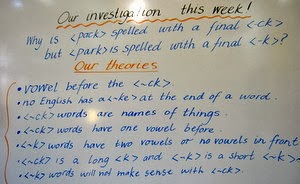
As with all structured word inquiry we would start with an investigative question to lead an inquiry about an important suffixing convention: such as, suffixing with the final single, silent <e>; when suffixing forces doubling; plural suffixes.
This particular investigation focused on the 
doubling suffixing convention for monosyllables.
During the week the students recorded their hypotheses 
about the investigation. The hypotheses are generally 
recorded during the daily morning tasks. 
An important part of the initial learning journey is providing opportunities for all students to express their thinking. 

Some children already have the necessary skills to express themselves effectively while others will need support to express themselves in the written form.
This particular investigation focused on the two forms of the 
plural suffix <-s> or <-es>. 
I recorded the students' theories to clarify their thinking and 
model effective ways to express the theories.


Once the students have experienced working with some basic suffixing conventions they begin to refine their language, expressing their hypotheses with greater clarity and more accurate terminology.
This is a summary of the children's hypotheses. Initially all ideas are accepted. As you can see some of the hypotheses demonstrate greater understanding of the concept than others. It is a great assessment piece. With this particular investigation the students wrote their hypothesis on a 'post it' note, shared it with a partner and then together, 
as a class, we compiled the different ideas. 
Think-pair-share is a collaborative activity that is often used to ensure 
all learners have a 'voice'.
After discussion of the investigative question and recording of hypotheses, the students participate in a variety of collaborative and independent activities to critically examine the orthographic pattern or convention that is being investigated. It is usually at this stage in the journey that I introduce the flowchart.

Investigating the purpose and process of a flowchart:
The flowchart is cut into large pieces, with the questions/decision boxes on diamond shaped card, actions on rectangular shape cards and a set of linking arrows. The children discuss the different components and meaning of the flowchart. Some children have likened it to a 'river flowing' or 'pathway through a forest'...with the arrows linking the pathways.

As a group, we examine the process of revealing each individual piece of the flowchart; reading, discussing and understanding the questions (decision boxes) and actions. Sometimes I read the text, other times I ask the children to read one of the questions/actions. In pairs they discuss what it means. As the children become more proficient with flowcharts they begin to predict the questions and actions with greater accuracy. They know what is expected in the text of a flowchart. 

Creating the flowchart, working out the puzzle pieces: 
This part of the learning journey is a whole group, collaborative activity. I want to model good learning, reinforce accurate vocabulary, restate the purpose of the flowchart, consolidate the meaning of the questions/actions and guide the students where necessary. Constructing a flowchart that flows effectively can be challenging for both younger and older children and so modelling how to link the arrows is very helpful for children.
Suffixing with the final, single, silent <e> is one of the
simplest flowcharts to construct and I generally start 
with this critical suffixing convention with all age groups.
With younger children, the flowchart is created during a series of short, explicit lessons. During the first session the children create the first part of the flowchart, linking the elements with the arrows and then continue the following days or subsequent sessions. 
The linking arrows are purposefully left blank 
so the students can 
decide whether it will be a 'yes' or 'no' arrow.

The emerging flowchart puzzle is placed in a learning space so the children have opportunities to manipulate the pieces, as 
indicated in these images.

It is critical that the children follow the flowchart physically, following the pathway of the arrows with a finger or hand, simultaneously reading each section. This kinaesthetic action ensures the flowchart will be effectively internalised.

Checking and testing for accuracy: Once the large flowchart has been created the students choose known words or word sums to check the organisation of the flowchart and make any necessary adjustments to the flowchart. The children use small whiteboards to create appropriate word sums checking for any changes with the completed flowchart. Often the children will notice they have placed the yes and no arrows incorrectly. At this stage, the flowchart is not adhered to any surface so it can be continually manipulated and changed.
 
The students are checking the flowchart by constructing known
word sums, deciding whether to replace or retain the final, single, silent <e>.
Problem solving: 
Once the large flowchart has been created and checked the students build their own individual flowcharts. The children create an individual flowchart on a small whiteboard, so they can manipulate and change where necessary. When the children have checked their flowchart with known word sums, a final copy is created.

The children need to read each question and 
action to make informed decisions about
the placement of the pieces.
Using problem solving strategies to construct the flowchart for the final <f> or <ff>.  
The students are working with a partner to complete an independent flowchart, 
helping and supporting each other.
Choosing <k> or <ck> in the final position of a base.
The students highlight new vocabulary introduced
in the flowchart. 
While the students independently construct their own flowcharts I work with small groups of children to support their learning and understanding.
Internalising the process:
The children build word sums analysing suffixing changes using the flowchart to support their decision making. 

A completed flowchart with the linking
arrows for the decision boxes.
Doubling the final letter for monosyllables.
Suffixing with the final, single, silent <e>.
By building and analysing word sums
children begin to internalise this
critical suffixing convention.
Students collaborating and analysing a 
completed flowchart.


To reinforce and consolidate learning the students can take home the flowchart pieces and recreate it with their family, explaining the suffixing pattern. A great homework project that involves the family working together. 


My journey...new understanding:
NB Since posting this orthographic investigation, I now use the more linguistically accurate terminology for the single, final non-syllabic <e>. 
Understanding the functions of the single, final non-syllabic <e> can be viewed on this VIDEO clip on the Real Spelling site.