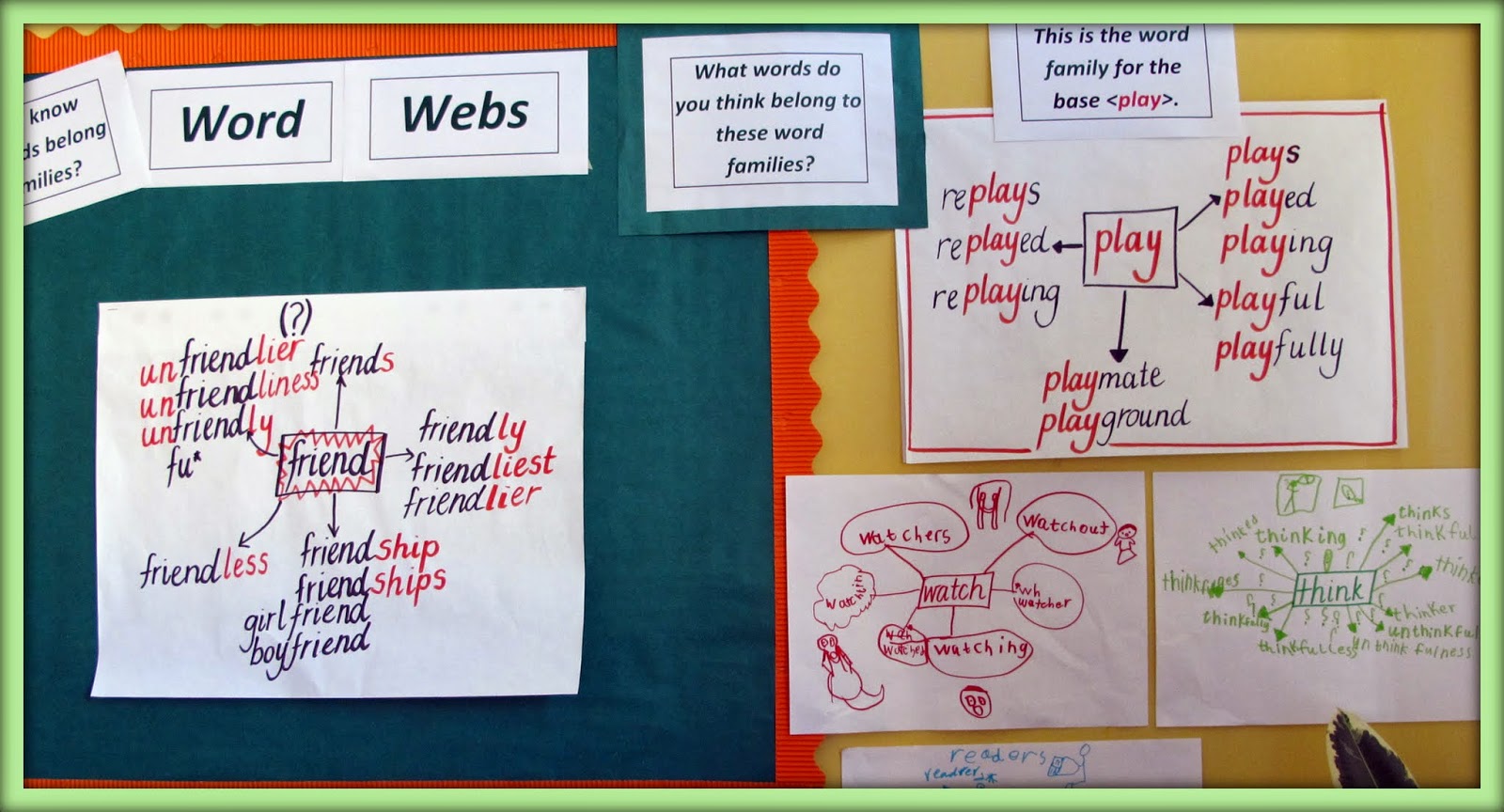
- Unravelling the 'story' of one word reveals the intertwined 'stories' of many other words.
- Investigating <one> clearly demonstrates that meaning and structure are the main concern of English orthography not pronunciation!

A teacher recently asked, "How can you investigate all the 'sight words'...that seems impossible?"
Do you know the singer/songwriter Paul Kelly? One of the songs he sings strikes a chord with me. Its called "From little things, big things grow." That's what happens when you dig deep with one, small word...learning grows, change happens, hypotheses form!
This is our inquiry into the reason for the initial grapheme <o> and
the final, single, silent <e> in the spelling of <one>?
What does it mean?
 |
| We determined, as a class, that <one> must be the base because we couldn't 'peel away' any structural affixes. |
What is its structure?
Even though it seems quite obvious that <one> is the base it is important to consistently model the process of providing evidence when identifying the morphemes. We determined that <one> must be a base as we couldn't justify any known affixes.
Also, the children immediately hypothesised that if <one> wasn't spelled with the final, single, silent <e> then it would be the function word <on>. Study Real Spelling's tutorial to understand the lexical and function word convention. Often the final, single, silent <e> is only taught in terms of its function to indicate that a previous vowel is long. However, it has many varied and important roles in English spelling that need to be discovered and investigated.
What are its relatives?
Our next task was to identify other words that could be related in meaning and structure.
One student suggested <ones>... "You know, the ones as in the tens and ones".
The children were perplexed that they had difficulty thinking of other related words. I suspect this is what happens when words are learned in isolation...we really do limit learners' ability to think 'beyond'. I predicted this would be a challenging part of the investigation, so I had prepared a word bag with possible words.
During this investigation I wanted the children:
- to dig deep to find clear evidence that the hypothesised words were actually related and connected.


Included in the word bag were words such as:
<only> <once> <no-one> <none> <alone> <lonely> <atone> <onion> <lonesome>
Some of these words would be unfamiliar, adding to
the children's expanding lexicon.
As each word was revealed, the children were surprised and delighted to discover words that they would not have previously thought of. The children also realised the different pronunciations of the <o> in each word. This reinforced the importance of naming the base by announcing it-pronunciations shift according to the affixes that are fixed.
 |
| The children loved that <alone> meant 'on your own-just one person', now recognising its connection to <one>. They had no difficulty identifying the <al-> prefix and then constructing the word sum: al + one --> alone However, I did explicitly help the children identify other words where <al-> was also evident as a prefix, such as <altogether> <always>. The children hypothesised that <al-> seemed to be like the base <all> in meaning! |
 |
| <none> The children suggested "not any" and I deepened their learning by adding: "like 'not one'." The children wondered about <n-> as a prefix. A great question...which I briefly discussed, without overloading with too much information. I modelled a hypothesis for the word sum n(e) + one --> none indicating that <ne-> was an old English prefix meaning 'not, no'. With an older group of children this would have been placed on the 'wonderwall' for small group or independent investigation. |

<lonesome>: an unfamiliar word for many of the children.

Stories have a significant impact on young children's learning (or probably any age really)...
...stories stick, they make sense-it's how the brain remembers
important information and makes connections.
Each time we discovered a word we attempted to construct a word sum to identify if the word had <one> as part of its structure. They loved discovering the story of <only>, realising the word sum as: one + ly --> onely.The children wanted to study this word further to discover what happened to the <e>...and agreed that it should be part of the spelling. So much rich discussion and thought from just one small word!
 |
| What about <onion>? |
Did you know that <one> and <onion> were related?
Such a surprising but important discovery.
Revealing the word <onion> caused much surprise and laughter and exclamations that <onion> couldn't possibly be related.
"Well let's check first...how about we find the word in our word origin book.
Remember how we discovered that <turn> and <turnip> were related?"
I modelled how to locate and read the necessary information to the children. Surprisingly we discovered that onion came from the Anglo French 'union' and was clearly related to 'one,unity'.Remember how we discovered that <turn> and <turnip> were related?"
To help the children absorb and understand this information I drew an onion...we discussed the part that lived under the soil (the bulb)...the part that we eat. Then I drew garlic (the children knew garlic as it is a major ingredient in many Indonesian dishes and so were familiar with it) and we discovered that garlic had lots of bulbs but onion only had one bulb.
Then by constructing the word sum <one/ + ion --->onion> we were able to
provide evidence of the same structure.
The kids loved this and were very eager to share this amazing information with their families.For the full story view Gina Cooke's inspiring TED movie Making Sense of Spelling explaining the connection of onion to one. Brilliant!

To finish this first session the children chose a word and shared its meaning as a reflection of their learning and understanding.
 |
| We placed the selected words on the word web, beginning to make sense of the base <one>. |
Discovering more: origins of <one>.
 |
| This student is recording important information about the word <onion> and its connection to <one>. |
The following day we returned to our investigation and revisited what we had previously discovered.
I started this session with John Ayto's Word Origin books. In pairs, the children identified <one> and I summarised their findings. We discovered that <one> was an Old English word spelled <an> and was also the source of 'an' and 'a' and was pronounced in the same way as <only> during this period of time!
We then constructed a more permanent word web. Each student recorded the 'story' of one word to add to the word web. As each child scribed their word they were reminded to announce the morphemes and graphemes.
 |
| <atone> a new word for the children <at + one --> atone> literally 'at one' with oneself. |
 |
| We had an interesting discussion about <once> and decided it should belong in the 'inner' word family because of its history OE 'anes' (same root as 'one'). |

"The word web doesn't have all the words...it's not complete...it doesn't have all the story... BUT it's enough for now to help these children
truly deepen their learning in so many ways."
 How many words have we discovered and investigated, just from one word?
And I'm absolutely certain that these children not only know how to spell <one> but more importantly know why!
The children also shared their learning at the school assembly!


This was a rich investigation involving inquiry, questioning, study, leading to our next investigation: <two> and why the <w>?


 |
| One student described <twilight> as "the zone between midnight and sunlight!" |

 The children identified the grapheme sequence (t+w) as having the meaning of 'twoness'.
The joy of unravelling the stories!
For further orthographic study refer to the Real Spelling Toolbox2:
- Kit 3 Theme J The spelling of numbers
- Kit 1 Theme D The functions of final, single, non-syllabic <e>

Give me a shout!
If you happen to be using my blog please drop me a line and let me know what you think, what you would like to see, what you enjoyed! inquiry.beyondtheword@gmail.com