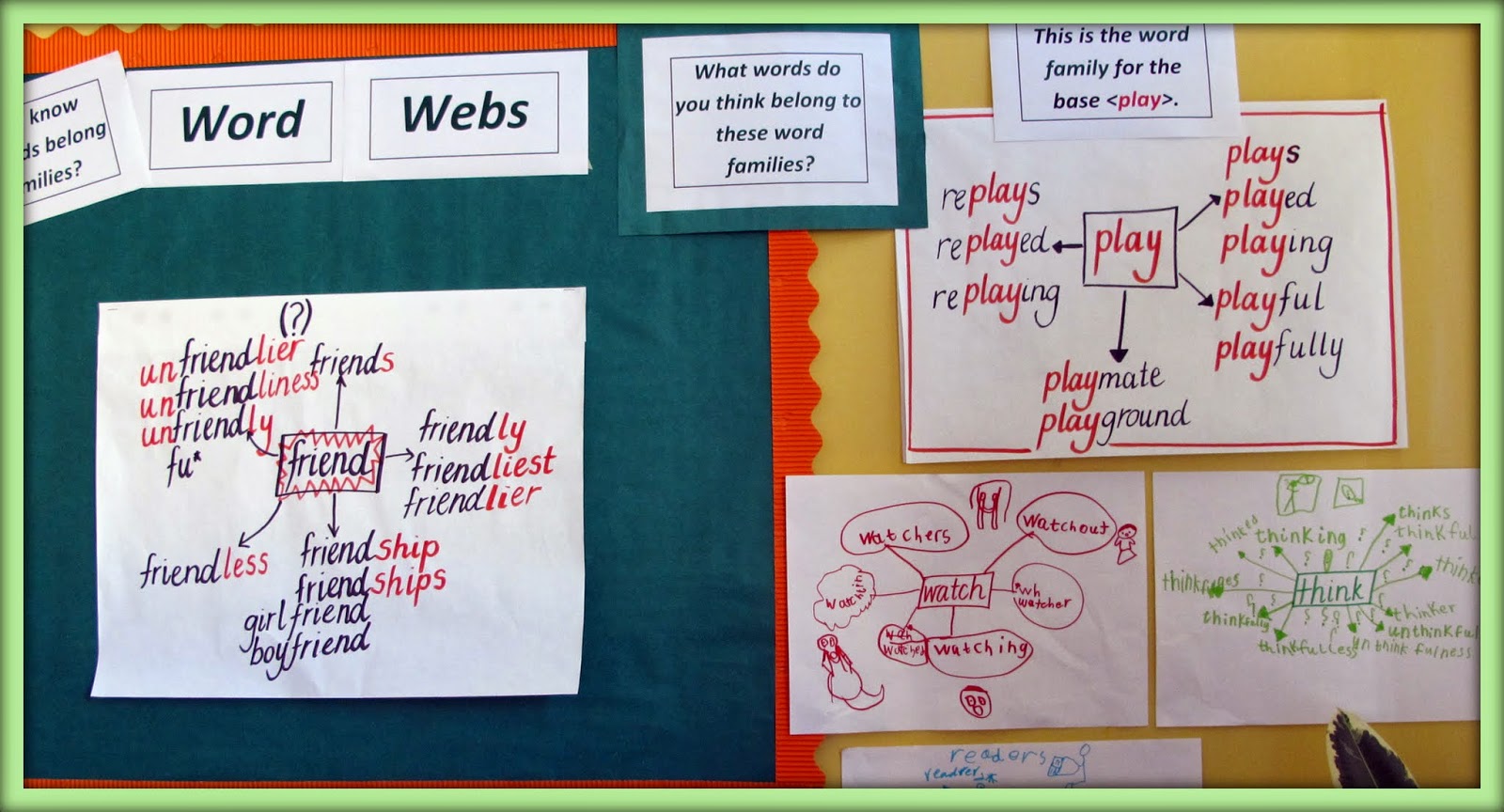
YES!...recently I had the wonderful opportunity to guide a group of inspiring, enthusiastic 4 and 5 year old learners. Together, we embarked on an incredible journey of 'digging' into the depths of the English language.
Here is an account of our learning journey and our amazing discoveries!
Our inquiry: Words belong in families, connected by meaning and spelling.

Prior to embarking on our journey, I likened words to people families and demonstrated how members of my family were linked: 'people live in families so do words'.
We illustrated this idea, discussed how families are different/similar and how families are connected.
 First stop! Choose a starter base from the 'word bag' (play) (a familiar base that young children can easily relate to). We discussed the meaning individually, in pairs and with the whole group.
Next stop! Delving into the word bag...Does this word (playing) belong to the family of (play)?
Think/whisper to your partner/let's share ideas with the group.


Moving on! More words to pull out of the bag...Do they belong or not? How do we know?
(I also included a few other words (painted) (painting) that did not belong to the family of (play). These words were used to start another word family, created the following day.
 And finally: Identifying the reason why these words belong in the family of (play); creating a word family chart; illustrating our understanding and then sharing our learning!

Here is an account of our learning journey and our amazing discoveries!
Our inquiry: Words belong in families, connected by meaning and spelling.
Teaching strategies:
1. 'Concept attainment'- learners make their own learning discoveries. Usually presented as a Venn Diagram.
Prior: identify what needs to be discovered. During: learners think independently/to self about concept. After: learners reveal the reason why these words are connected.
2. Think/pair/share- all learners are actively involved. Used frequently throughout the lesson in different formats and ways.
We illustrated this idea, discussed how families are different/similar and how families are connected.
Next stop! Delving into the word bag...Does this word (playing) belong to the family of (play)?
Think/whisper to your partner/let's share ideas with the group.
Moving on! More words to pull out of the bag...Do they belong or not? How do we know?
(I also included a few other words (painted) (painting) that did not belong to the family of (play). These words were used to start another word family, created the following day.