Showing posts with label Etymology. Show all posts

Monday, 24 November 2014

The power of one!


Although this article is about a number of significant orthographic principles there are two topics that are particularly pertinent for me:
  • Unravelling the 'story' of one word reveals the intertwined 'stories' of many other words.
  • Investigating <one> clearly demonstrates that meaning and structure are the main concern of English orthography not pronunciation!

Recently, during math week, we investigated the number words, a wonderfully rich source of orthographic understandings. In education, <one> is generally considered a 'sight word' or a 'high frequency word', often a word memorised in isolation. It only seems logical to me, if words are considered high frequency, then we should be investigating and analysing them to fully understand the 'how' and 'why' of the spelling.

A teacher recently asked, "How can you investigate all the 'sight words'...that seems impossible?"
Do you know the singer/songwriter Paul Kelly? One of the songs he sings strikes a chord with me. Its called "From little things, big things grow." That's what happens when you dig deep with one, small word...learning grows, change happens, hypotheses form!

This is our inquiry into the reason for the initial grapheme <o> and 
the final, single, silent <e> in the spelling of <one>?

What does it mean?
We determined, as a class, that <one>
must be the base because 
we couldn't 'peel away' any 
structural affixes.
As in all orthographic investigations we began with a discussion of the meaning of <one>, which included a discussion about the homophone <won>. We briefly discussed how <won> was the past tense of <win>, hence the initial, single grapheme <w> indicating the connection between these words. The students had no difficulty dealing with the concept: different meanings, different spellings where possible.

What is its structure?
Even though it seems quite obvious that <one> is the base it is important to consistently model the process of providing evidence when identifying the morphemes. We determined that <one> must be a base as we couldn't justify any known affixes.

Also, the children immediately hypothesised that if <one> wasn't spelled with the final, single, silent <e> then it would be the function word <on>. Study Real Spelling's tutorial to understand the lexical and function word convention. Often the final, single, silent <e> is only taught in terms of its function to indicate that a previous vowel is long. However, it has many varied and important roles in English spelling that need to be discovered and investigated.

I wanted the children to begin to understand the various functions of the final, single, silent <e> which we will be investigating soon.

What are its relatives?
Our next task was to identify other words that could be related in meaning and structure.

One student suggested <ones>... "You know, the ones as in the tens and ones".
The children have recently been investigating place value and the numerical position of digits. I was thrilled this student was able to make connections with other learning.
The children were perplexed that they had difficulty thinking of other related words. I suspect this is what happens when words are learned in isolation...we really do limit learners' ability to think 'beyond'. I predicted this would be a challenging part of the investigation, so I had prepared a word bag with possible words.
During this investigation I wanted the children:
  • to dig deep to find clear evidence that the hypothesised words were actually related and connected.


Included in the word bag were words such as:
<only> <once> <no-one> <none> <alone> <lonely> <atone> <onion> <lonesome>
Some of these words would be unfamiliar, adding to 
the children's expanding lexicon.

As each word was revealed, the children were surprised and delighted to discover words that they would not have previously thought of. The children also realised the different pronunciations of the <o> in each word. This reinforced the importance of naming the base by announcing it-pronunciations shift according to the affixes that are fixed.
The children loved that <alone> meant 'on your own-just one person', 
now recognising its connection to <one>.
They had no difficulty identifying the <al-> prefix and then constructing the word sum:  
al + one --> alone
However, I did explicitly help the children identify other words where <al-> was also evident as a 
 prefix, such as <altogether> <always>. 
The children hypothesised that <al-> seemed to be like the base <all> in meaning!
<none>  
The children suggested "not any" and I deepened their learning by adding: "like 'not one'."
The children wondered about <n-> as a prefix. A great question...which I briefly discussed, without overloading with too much information. I modelled a hypothesis for the word sum 
n(e) + one --> none  
indicating that <ne-> was an old English prefix meaning 'not, no'. 
With an older group of children this would have been placed on the 'wonderwall' 
for small group or independent investigation. 
<lonesome>: an unfamiliar word for many of the children.

 I told the children that <lonesome> was like a 'cousin' to <one> and that we would discover why with some other words, not yet revealed.


As each word was revealed we discussed the relationship between <lonely> <loneliness> <lonesome> and related the 'story' of how the base <lone> came into the English language.
Stories have a significant impact on young children's learning (or probably any age really)...
...stories stick, they make sense-it's how the brain remembers 
important information and makes connections.

Each time we discovered a word we attempted to construct a word sum to identify if the word had <one> as part of its structure. They loved discovering the story of <only>, realising the word sum as: one + ly --> onely.The children wanted to study this word further to discover what happened to the <e>...and agreed that it should be part of the spelling. So much rich discussion and thought from just one small word!
What about <onion>?
Did you know that <one> and <onion> were related?
Such a surprising but important discovery.

Revealing the word <onion> caused much surprise and laughter and exclamations that <onion> couldn't possibly be related.
"Well let's check first...how about we find the word in our word origin book. 
Remember how we discovered that <turn> and <turnip> were related?"
I modelled how to locate and read the necessary information to the children. Surprisingly we discovered that onion came from the Anglo French 'union' and was clearly related to 'one,unity'.

To help the children absorb and understand this information I drew an onion...we discussed the part that lived under the soil (the bulb)...the  part that we eat. Then I drew garlic (the children knew garlic as it is a major ingredient in many Indonesian dishes and so were familiar with it) and we discovered that garlic had lots of bulbs but onion only had one bulb.
Then by constructing the word sum <one/ + ion --->onion> we were able to 
provide evidence of the same structure.
The kids loved this and were very eager to share this amazing information with their families.
For the full story view Gina Cooke's inspiring TED movie Making Sense of Spelling explaining the connection of onion to one. Brilliant!


To finish this first session the children chose a word and shared its meaning as a reflection of their learning and understanding.

We placed the selected words on the word web, 
beginning to make sense of the base <one>.
The children hypothesised which words belonged to the 'inner family' and which they thought belonged to the 'outer family', like cousins. Initially the children were unsure about the connection of <once> but understood that it meant 'at one time'.


Discovering more: origins of <one>.
 This student is recording important information
about the word <onion> and its connection to <one>.
The following day we returned to our investigation and revisited what we had previously discovered.
I started this session with John Ayto's Word Origin books. In pairs, the children identified <one> and I summarised their findings. We discovered that <one> was an Old English word spelled <an> and was also the source of 'an' and 'a' and was pronounced in the same way as <only> during this period of time!

We then constructed a more permanent word web. Each student recorded the 'story' of one word to add to the word web. As each child scribed their word they were reminded to announce the morphemes and graphemes.
<atone> a new word for the children
<at + one --> atone>
literally 'at one' with oneself.
We had an interesting discussion 
about <once> and decided it 
should belong in the 'inner' word family 
because of its history 
 OE 'anes' (same root as 'one').
This is our word web identifying words related in meaning and structure.

"The word web doesn't have all the words...it's not complete...it doesn't have all the story... BUT it's enough for now to help these children 
truly deepen their learning in so many ways."

Maybe our hypotheses will change as we come across more evidence.
How many words have we discovered and investigated, just from one word?

And I'm absolutely certain that these children not only know how to spell <one> but more importantly know why!

The children also shared their learning at the school assembly! 


This was a rich investigation involving inquiry, questioning, study, leading to our next investigation:                              <two> and why the <w>?
 

 One student described <twilight> 
as "the zone between
midnight and sunlight!" 


The children identified the grapheme sequence (t+w) as having the meaning of 'twoness'.
The joy of unravelling the stories!

For further orthographic study refer to the Real Spelling Toolbox2:
  • Kit 3 Theme J  The spelling of numbers
  • Kit 1 Theme D The functions of final, single, non-syllabic <e>
Give me a shout! 
If you happen to be using my blog please drop me a line and let me know what you think, what you would like to see, what you enjoyed!  inquiry.beyondtheword@gmail.com

Tuesday, 16 September 2014

friend...real connections, real stories

Real Connections: MEANING, STRUCTURE, RELATIVES, PRONUNCIATION
<friend> 
... such a valuable and interesting word to investigate at the beginning of the school year...
I love that this word has a non-phonemic letter to demonstrate that not all letters in an English word will represent pronunciation. 

I love that this word explicitly demonstrates that the primary function of English spelling is to represent MEANING, not pronunciation.

I have been working with a group of young students whose previous spelling instruction has primarily been based on thinking that spelling represents sound.

"Time to change their thinking by explicitly demonstrating and investigating 
how the English spelling system really works."

I want the children to be able to spell <friend> accurately from the very beginning of the school year but  more importantly I want them to know why it is spelled this way; I want them to understand that not all letters in a word are there to represent pronunciation; I want them to know that some letters are etymological markers which give us important clues about the spelling. I want the children to be on a learning journey of discovery and understanding...

How did I choose <friend> for investigation?
This was a central word as part of the initial discussion and development of the class essential learning agreements early in the school year, in conjunction with many others like: <respect> <safety> <collaboration>. All ripe for future word investigation and inquiry!

From the beginning of the school year the children were consistently challenged to think about the how and why of words. We constructed many word families using words from the first PYP Unit of Inquiry. They were introduced to important terminology; base, suffix, prefix, meaning, structure.
After only one month the children are already  beginning  to analyse/synthesise words based on this growing understanding.

Setting the scene
We presented two questions:
 I deliberately used the terminology 'word' not 'base' in this
question so that the children would consider another
possible base.
Initially I chose to present <friend> as
the base but  I also presented this question
to provoke and challenge the children's thinking.
I wanted to see if anyone would
 hypothesise <fri> as a possible base.

1. What does it mean? Predictably the children discussed the idea of 'friendship' connected to their personal experiences.
2. What is the structure of the word? The majority of the children hypothesised  <friend> as the base. Predictably one child presented <fri> (as in <fry>)  which led to an important discussion about meaning and how <fry> has no meaning connection to <friend>. 

Consistently, I observe children needing this fundamental concept to be revisited over and over again to help them fully understand the importance of both meaning and structure as the key to the connection.
3. What are its relatives?
The first activity was a think/pair/share. Individually, the children wrote one or two (or more) words related to the word <friend> on a piece of paper. This was an initial assessment piece to ascertain the children's present understanding of how words are related in meaning and structure. The children then collected further words, to add to their original list, by sharing with each other. They moved from partner to partner until they had collected an extended list. It was incredibly exciting to watch the children actively discussing and trading each other's words. 
The children are writing a collection of words
related to <friend>

The children shared their hypotheses with each other and
added to or modified  their own list of  words.
I had the absolute joy of overhearing one student tell another student (who offered <fri> and <end> as  two related words) that they couldn't belong in the family of <friend> "because they didn't have the same meaning or the same spelling."  He then proceeded to give the other student clear evidence by providing his three words (friendly, friends and befriended) to demonstrate what he meant. No need for adult intervention here...Max had certainly provided the necessary teaching. I shared this observation later  as we revisited the fundamental concept of  how words are related in meaning and structure.

Can you see how valuable this initial activity is in terms of assessing children's understanding throughout the learning process? 
The other valuable part of this activity is the expectation that all children will actively participate, regardless of where they are on their learning pathway; and the opportunity to learn from each other, as demonstrated above, cannot be underestimated. 
A student is extending her list of
related words by trading with her
classmates.

As a whole group, we shared and recorded the words on a word web. I explicitly stated, every time, how the words were related in meaning and structure; and how new words were constructed. 

What did you do to construct this word <friendly>? 
...consistently asking the students to clarify and provide evidence...
How do you know <-ly> is a suffix?


The word bag!
A student, who currently speaks very little English, had the job of extracting words from a word bag, to check if there were others we could add to the current word web. I placed two words for provocation  in the bag: <fried> and <Friday>.  The children suggested that both <fried> and <Friday> couldn't belong in this word family because they didn't have the same meaning. We decided to leave these words off the word web until we had provided some evidence. You will notice that even though I knew, as a teacher, that <Friday> was related, that I didn't share this information at this particular time on their learning journey. My goal was to guide them to their own understanding of this relationship.

However, I did ask the question "I wonder what Friday means?" to challenge their thinking and hopefully jog their previous learning about the days of the week. One student suggested that Friday was named after Frigga! "I know her!" counteracted many of the other children.

An Etymological Study!
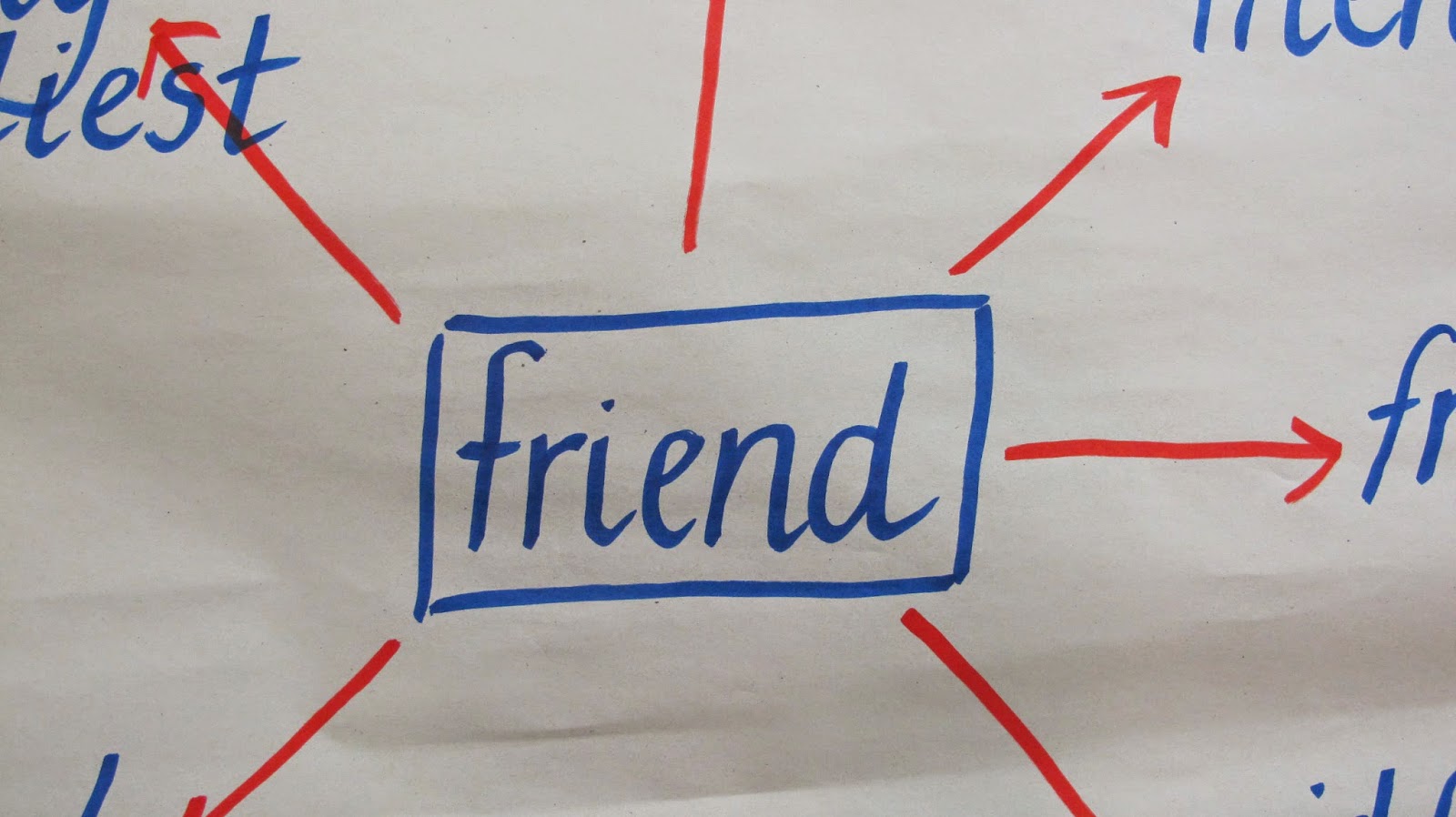
As I told the historical 'story" I wrote key words,
pictures and connecting arrows to demonstrate
the 'big picture'.
The children also recorded the story
on individual whiteboards.
The following day I related the historical 'story' of 'friend' by linking the word to 'Friday' and 'Frigga'.  
We studied images of the Romans and the Germanic peoples, explaining how the days of the week evolved through history. The children could clearly see the connection between Friday and Frigga.

I modelled how to use the Word Origin Dictionary to discover further important historical information about 'friend'. For many this was new.
<friend> was written on a post-it note to indicate where in the dictionary it was located. A child was selected to open to the page and locate the word <friend>. 
I summarised the relevant information highlighting the diachronic meaning; 'loving' Old English 'freond'; Proto Germanic 'frijand'.
The children were now able to ascertain a clearer connection with 'Friday' and 'Frigga'. 
The <i> is present to show its meaning connection to <Friday> and historical connection to 'Frigga', the Germanic Goddess of love.
The children are recording the history
of <friend> as we discuss it together.
Of course this is not the full etymological story of the word <friend>. You can trace its history way back from the PIE root 'pri' meaning 'to love'. One student has recently discovered that <free> is related too!

A closer investigation of the structure of words and the 'spelling out' strategy
In subsequent lessons we investigated the structure of each of the words from the word web. Beginning with a blank matrix we gradually added the appropriate affixes to construct new words. 
I explicitly modelled the construction of the word sum, demonstrating the 'spelling out' strategy, critical for internalisation. The children practised constructing the word sums on individual whiteboards.
                                   
I briefly introduced how to identify and check for any changes.  "Stop, check for changes, change the y to an i" as in this word structure: <friend> + < ly/i> + <er> --> friendlier
For now, I only needed the children to understand that there might be a change caused by a suffix. Investigation                                                                        of the <i/y> suffixing convention would happen in the                                                                            future.


During the next few days we constructed additional words, writing the word sum to demonstrate the underlying structures. You may notice that the matrix is not completed and it won't be for sometime. This 'work in progress' is an indication of the children's learning journey; an understanding that we could add, change, modify the matrix and word web as our learning deepens. 
More information is gradually
added to the matrix as we revisit
meaning, structure, history
and connections.
Throughout the process one student consistently wanted to know how could we add <Friday> to the matrix. He had developed a hypothesis that <fri> was the base, based on the structure of <Friday> Fri + day --> Friday
I had this blank matrix ready to demonstrate his hypothesis. We will revisit this matrix and discuss how it could be constructed at another time. It is there for provocation, thought and discussion. 

Time to consolidate
The following week the children  independently constructed word sums from a variety of matrices.  
I can assure you by this stage all the children are spelling <friend> accurately and they know why there is an <i>! 
You will notice that the matrices are different, varying in complexity. At times I choose the matrices for the children, other times they choose. One student added to the complexity of his matrix, demonstrating his own deep understanding of the underlying structures of words.  
The children chose words to write in sentences or illustrate to show the meaning; they constructed words at home to teach their families.
 

We have been revisiting the structure of words by constructing large word sums to identify the morphemes and graphemes in the base and the underlying changes.
In this session the children had one piece of the word sum, on a large piece of card.
Together they had to sequence themselves to form the final word sum. Collaboration in action.
This beats memorising a list of unrelated words!
What about pronunciation?
Throughout the whole learning process the children were introduced to 'tasting and feeling' phonemes. We have started to look more carefully at what is happening in our mouth and throat as we sequence the important phonemes in a word. 

Learning is a journey; a journey of discovery and connections...and so our journey continues!

You can go to Real Spelling, Toolkit2 Kit2 ThemeL Naming the Days of the Week, for the full story of <friend>.

and Pete Bowers Word Works Spelling Out Word Structure
Give me a shout! 
If you happen to be using my blog please drop me a line and let me know what you think, 
what you would like to see, what you enjoyed!