Wednesday, 23 April 2014

Teaching Orthography in the Early Years: word webs for young children

The primary function of English spelling is to represent MEANING. 
Implementing orthography, 
through scientific inquiry, in the early years. 

As I continue on my learning journey, and work with young children in a variety of learning settings, it is consistently validated that teaching morphology to the youngest is not only essential but critical to their success as proficient language users.  

As we know and understand from research, morphology is the building block, the solid foundation, for understanding how the English spelling system works. It provides a meaningful structure for teaching and learning phonology in an effective and authentic way.

In this post, I would like to share a wonderful learning story of a group of young children who are currently embarking on a journey of orthographic understanding.

This structured word inquiry was explicitly embedded in an authentic literacy learning experience, integrating all forms of language.

Throughout the learning experience the children clearly demonstrated their deep understanding of how words are connected in meaning and structure. 


We started this particular learning journey by rereading a well loved story, Mrs Wishy Washy by Joy Cowley.The children were delighted to read the story to me, which they did with great enthusiasm and understanding.They clearly viewed themselves as proficient readers, by explaining and discussing the underlying ideas and meaning of the story. 

I shared my favourite part of the story, by writing a sentence to demonstrate and model my thought processes, emphasising the word <jumped>. Hence, the starter base for this investigation is <jump>.

The cow jumped in the mud. 

I have also observed  a teacher of another prep class require the children to draw their thinking about the starter base before embarking on the word family activity. A very valuable, authentic assessment of children's understanding and learning!

Concept attainment:
We then dived into the 'bag of words' and pulled out the word    <jumped>, written on a large chart. 
             jumped
"Jumped," shouted the children with glee. 

By ensuring the children had meaningfully encountered this word in a reading and writing context all the children were able to make true sense of the word. 

I modelled how to announce the spelling of <j-u-m-p-ed> by spelling aloud the single letter graphemes and the suffix. This word was placed inside a hoop. The children orally shared their understanding of the meaning of the word through their own life experiences. 

The bag of words also contained <jumped> <jumping> <jumper> <jumps> as well as two others <rolled> and <paddled>.

We then proceeded to pull out further words making decisions together if the word belonged inside the hoop or outside the hoop. Each time we viewed a word I announced the morphemes and graphemes. 

In pairs, the children discussed the words inside the hoop and then shared their hypotheses of why <jumped> <jumping> <jumps> and <jumper> belonged to the same morphological word family but <rolled> and <paddled> did not. The children did this with exceptional focus and interest.


The children recorded their thinking by illustrating the meaning of the words in the hoop. As the children were writing their chosen word, this created further opportunities to model the spelling out strategy.

After recording their thinking the children created a word web to record how the words are linked in meaning and structure. 


Again I announced the morphemes and graphemes, reinforcing new terminology and concepts. The children decided they needed to construct additional word webs for <rolled> and <paddled> and I have no doubt that they could accomplish this effectively through a similar inquiry investigation.


Every time I share this activity with children it confirms, consolidates and ratifies the utmost importance of implementing morphology in the early years. Right from the very beginning young children need to fully understand that the primary function of English spelling is meaning.

Now, let's think about the phonological connections 
that are explicitly embedded in this activity.

During this particular SWI lesson the children are consistently revisiting and consolidating the names of 4 alphabet letters 
<j> <u> <m> and <p> 

They are implicitly introduced to four single letter graphemes 
<j-u-m-p>

and the phonemes these graphemes are representing in the base word <jump>
// /u/ /m/ /p/

In the following weeks you could choose another starter base, like <play> and highlight the circumstances of the single letter grapheme <p> in this base word and compare it to the circumstance of the single letter grapheme <p> in <jump>.

The children can investigate and discuss if <p> represents the same or a different phoneme when the <p> is in the initial and final positions of these two base words.

<play> presents a meaningful introduction to the digraph <ay>, a team of letters working together to represent the phoneme long /a/, in the final position.

Additionally, this would naturally lead into an introduction of the six vowel letters, and an investigation, of the importance of these letters in understanding the spelling of a base. Please refer to the blog post The Power of Kinaesthetic Learning for further information regarding the teaching of vowels.

In just one lesson the children have been meaningfully introduced to a variety of important morphological and phonological 
concepts and terminology. 

Thursday, 6 February 2014

An Exceptional Learning Tool: The Flowchart


Constructing learning using a powerful learning tool, to engage and empower young children.

As with all linguistic learning tools, the flowchart is a powerful learning tool that consolidates and deepens understanding of complex but ordered orthographic processes. In this case they are used to investigate, test and internalise critical suffixing conventions.
When I first encountered the orthographic flowcharts I found them to be an inspirational tool to use with young children. They are highly interactive, systematic and challenging. 

Initially, I create a 'flowchart puzzle' for the children to collaboratively arrange. This requires the children to explicitly read and understand each element (the decision questions and the actions) in order to recreate a flowchart that 'flows' systematically towards an appropriate action. The collaborative discussion and interaction that results from this activity are phenomenal.

By manipulating the physical pieces of the flowchart, the children are able to develop a deeper understanding of what is required from the questions and actions. Using the kinaesthetic memory ensures learning is internalised, ensuring deep, long term understanding of the spelling pattern or convention. I love the fact that it mirrors what the brain does, helping to internalise important orthographic processes.

With young children, I generally introduce the flowchart once the children have gained some understanding of the spelling convention or pattern currently being studied. However, it can be introduced at any stage during the learning journey.

Here is a sequence of possible steps for introducing the flowchart process.

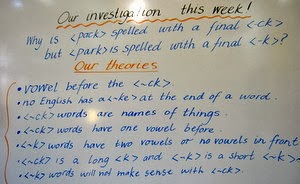
As with all structured word inquiry we would start with an investigative question to lead an inquiry about an important suffixing convention: such as, suffixing with the final single, silent <e>; when suffixing forces doubling; plural suffixes.
This particular investigation focused on the 
doubling suffixing convention for monosyllables.
During the week the students recorded their hypotheses 
about the investigation. The hypotheses are generally 
recorded during the daily morning tasks. 
An important part of the initial learning journey is providing opportunities for all students to express their thinking. 

Some children already have the necessary skills to express themselves effectively while others will need support to express themselves in the written form.
This particular investigation focused on the two forms of the 
plural suffix <-s> or <-es>. 
I recorded the students' theories to clarify their thinking and 
model effective ways to express the theories.


Once the students have experienced working with some basic suffixing conventions they begin to refine their language, expressing their hypotheses with greater clarity and more accurate terminology.
This is a summary of the children's hypotheses. Initially all ideas are accepted. As you can see some of the hypotheses demonstrate greater understanding of the concept than others. It is a great assessment piece. With this particular investigation the students wrote their hypothesis on a 'post it' note, shared it with a partner and then together, 
as a class, we compiled the different ideas. 
Think-pair-share is a collaborative activity that is often used to ensure 
all learners have a 'voice'.
After discussion of the investigative question and recording of hypotheses, the students participate in a variety of collaborative and independent activities to critically examine the orthographic pattern or convention that is being investigated. It is usually at this stage in the journey that I introduce the flowchart.

Investigating the purpose and process of a flowchart:
The flowchart is cut into large pieces, with the questions/decision boxes on diamond shaped card, actions on rectangular shape cards and a set of linking arrows. The children discuss the different components and meaning of the flowchart. Some children have likened it to a 'river flowing' or 'pathway through a forest'...with the arrows linking the pathways.

As a group, we examine the process of revealing each individual piece of the flowchart; reading, discussing and understanding the questions (decision boxes) and actions. Sometimes I read the text, other times I ask the children to read one of the questions/actions. In pairs they discuss what it means. As the children become more proficient with flowcharts they begin to predict the questions and actions with greater accuracy. They know what is expected in the text of a flowchart. 

Creating the flowchart, working out the puzzle pieces: 
This part of the learning journey is a whole group, collaborative activity. I want to model good learning, reinforce accurate vocabulary, restate the purpose of the flowchart, consolidate the meaning of the questions/actions and guide the students where necessary. Constructing a flowchart that flows effectively can be challenging for both younger and older children and so modelling how to link the arrows is very helpful for children.
Suffixing with the final, single, silent <e> is one of the
simplest flowcharts to construct and I generally start 
with this critical suffixing convention with all age groups.
With younger children, the flowchart is created during a series of short, explicit lessons. During the first session the children create the first part of the flowchart, linking the elements with the arrows and then continue the following days or subsequent sessions. 
The linking arrows are purposefully left blank 
so the students can 
decide whether it will be a 'yes' or 'no' arrow.

The emerging flowchart puzzle is placed in a learning space so the children have opportunities to manipulate the pieces, as 
indicated in these images.

It is critical that the children follow the flowchart physically, following the pathway of the arrows with a finger or hand, simultaneously reading each section. This kinaesthetic action ensures the flowchart will be effectively internalised.

Checking and testing for accuracy: Once the large flowchart has been created the students choose known words or word sums to check the organisation of the flowchart and make any necessary adjustments to the flowchart. The children use small whiteboards to create appropriate word sums checking for any changes with the completed flowchart. Often the children will notice they have placed the yes and no arrows incorrectly. At this stage, the flowchart is not adhered to any surface so it can be continually manipulated and changed.
 
The students are checking the flowchart by constructing known
word sums, deciding whether to replace or retain the final, single, silent <e>.
Problem solving: 
Once the large flowchart has been created and checked the students build their own individual flowcharts. The children create an individual flowchart on a small whiteboard, so they can manipulate and change where necessary. When the children have checked their flowchart with known word sums, a final copy is created.

The children need to read each question and 
action to make informed decisions about
the placement of the pieces.
Using problem solving strategies to construct the flowchart for the final <f> or <ff>.  
The students are working with a partner to complete an independent flowchart, 
helping and supporting each other.
Choosing <k> or <ck> in the final position of a base.
The students highlight new vocabulary introduced
in the flowchart. 
While the students independently construct their own flowcharts I work with small groups of children to support their learning and understanding.
Internalising the process:
The children build word sums analysing suffixing changes using the flowchart to support their decision making. 

A completed flowchart with the linking
arrows for the decision boxes.
Doubling the final letter for monosyllables.
Suffixing with the final, single, silent <e>.
By building and analysing word sums
children begin to internalise this
critical suffixing convention.
Students collaborating and analysing a 
completed flowchart.


To reinforce and consolidate learning the students can take home the flowchart pieces and recreate it with their family, explaining the suffixing pattern. A great homework project that involves the family working together. 


My journey...new understanding:
NB Since posting this orthographic investigation, I now use the more linguistically accurate terminology for the single, final non-syllabic <e>. 
Understanding the functions of the single, final non-syllabic <e> can be viewed on this VIDEO clip on the Real Spelling site.

Thursday, 28 November 2013

A Phonology Lesson: Analysing the Phoneme /f/


 Morphology, Etymology, Phonology
Although this lesson is focused on developing phonological understanding; 
as with all word building, morphology must provide the structural framework for any phonological learning.

The focal point of the phonological learning continues to be based on meaning: the structure of words; how words are related in meaning and then finally the sounds that make sense to the spelling.

Understanding how English phonemes can be 
represented by different graphemes.

This phonological learning journey started with the phoneme /f/
Our inquiry initially focused on investigating the three different graphemes 
that represent /f/ in spelling.
  • the single letter grapheme <f>
  • the digraph <ph>
  • the trigraph <ugh>
Setting the Scene: Where are we Headed?
This lesson began with a review of the meaning of the slash brackets / / and the angle < > brackets. 
(I have regularly introduced these brackets to young children to indicate whether we are starting our inquiry with a grapheme < > or a phoneme / /.)
Indicating that our word building inquiry was
focused on the phoneme /fthe students were 
given additional information that this phoneme 
can be represented in writing in 3 different 
forms;hence the three arrows.


After demonstrating the written form of the phoneme /f/ on the chart, we reviewed the pronunciation of /f/ by focusing on the 'taste and feel' of this phoneme. We discussed what part of the mouth/throat we were using. The students described the feeling in different ways.
"It's like blowing out your breath."
"It's like a small wind."
Added note: Changing to 'feeling and tasting' phonemes, rather than asking my young students to listen to sounds in a word, had a profound effect on my own teaching and learning. I have found it to be one of the most powerful and successful ways to help young children, and older, to experience and fully understand the sequence of phonemes in a word. To learn further about this please refer to the Real Spelling Manual or Toolkit


 Our word building inquiry:
What graphemes can we use to represent the phoneme/f/ in spelling?
How do we decide which grapheme to use when spelling?


A Learning 'Hook': A Bag of Words!
We began the learning journey by revealing a bank of bases, handwritten on cards. These bases were chosen specifically for this particular group of children...some familiar; some unfamiliarAs with all activities, the bases or words you choose need to be applicable to the age group and needs of your learners.

       
Our first task was to focus on meaning and build an understanding of the vocabulary before investigating the phoneme. Although this may take additional time with younger children it is considered a critical part of the initial learning process. 
The base cards were covered so that each base could be revealed and discussed one at a time. Each student reveals a base card to read, spell aloud and orally discuss the meaning; with teacher guidance and support when necessary. I frequently model the correct spelling, by verbally emphasising the correct graphemes: <f-r-igh-t>. 
This discussion also provides insightful opportunities for the students to reflect on how they would clearly express the meaning of the base, to their ESL classmates. 
       
How you determine the length and timing of this initial lesson will greatly depend on the age and needs of the children you are working with.

Here the term <phoneme> has been introduced and added to the phoneme chart.

This term was used and reviewed consistently throughout the inquiry;at different times during the learning process.Gradually introduce precise linguistic terminology,so young learners can value the importance, develop understanding and express themselves with greater accuracy.
A note about linguistic vocabularyCurrently in my teaching I am very careful not to refer to <sound> as this seems to give an indication to the children that they must 'listen' rather than more accurately 'feel and taste' the phonemes. As an educator on this learning journey, I require myself to use linguistically correct vocabulary, just as we do in all other areas of learning, so we are all very clear about our actions/goals. This is evident with the vocabulary used for PYP Units of Inquiry. Consistently the linguistic terminology <grapheme> <digraph> <trigraph> <phoneme> <matrix> <base> <suffix> etc are consistently modelled verbally and in the written form. Every time the students hear or see this new vocabulary, their understanding deepens. I often discuss with the children that graphemes are like 'teams of letters' that we write to spell a base and phonemes are what we pronounce and identify by 'tasting/feeling'.  
_____________________________________________________

Deepening Understanding: What is the Meaning?
During the same learning session or a subsequent lesson the students illustrate the base cards to identify the meaning. This is an additional opportunity to reinforce new vocabulary and assess understanding. Additionally, students can write sentences to demonstrate the meaning. With younger students we primarily use the words in oral sentences for discussion and elaboration.  
During this early collaborative, oral discussion time, the children usually begin to provide some initial theories about the graphemes representing /fin their particular base.


Reviewing Learning: The Trading Game
To revisit and review the vocabulary and meaning the students play the Trading Game. The students move around freely trading their base card with a partner, after explaining the meaning. The very nature of this game provides the opportunity for the students to be exposed to all the base cards; not just their own. I often play this game to review learning from previous experiences; one, because it engages purposeful thinking through movement; two, it ensures all children are actively participating; three, it gives quick, valuable feedback to the teacher about the children's understandings or misunderstandings.


Throughout the learning journey the children are reminded to say the base or word naturally, without stretching or distorting the pronunciation.


Identifying and Sharing Grapheme Theories: How can you give proof?

At this stage on the learning journey the students circle the team/s of letter/s they think is/are representing the phoneme /f/. 

This is conducted as a collaborative activity, where the children are supporting and helping each other to identify the grapheme. The age group of the learners, will determine how much teacher guidance and intervention is required. With very young children I usually guide the children, together as a group, by modelling the process for identification. All theories are accepted, investigated, reviewed and changed throughout the learning process. 

Often, an interesting assumption is that <gh> is the grapheme, not <ugh>. This can be added to the Wonder Wall for further investigation. I was thrilled when working with this particular group, that one child had identified <ugh> as the grapheme, not <gh>. She had previously discussed this with me when we were having a reading conference and had encountered the word <laugh> in the text.
An ESL student is recording her initial
theory about the three graphemes.
You will notice she has written
<gh> as one of the graphemes.
Although this grapheme is not fully accurate,
 it is still accepted as a hypothsis for investigation.
Along her learning journey she was able to identify that
the trigraph <ugh> was the more accurate grapheme.

Making Connections: through Concept Attainment.
After completing the Trading Game and identifying grapheme hypotheses; the base cards are returned, shuffled ready for the concept attainment activity.

As stated in previous posts, the concept attainment
strategy guides children through an inquiry process, to their own understanding of a learning concept. This strategy ensures all the students are critically thinking and actively involved by taking ownership of their proposals and hypotheses; it allows all learners a critical thinking 'voice' and a deeper understanding of the concept introduced or revisited. 
You will notice at this stage in
the learning journey that we
haven't recorded the
three graphemes; only added
the words for consideration.


The students place their base cards on the chart as directed by the teacher, developing a understanding about the three graphemes.

The phoneme/grapheme chart is displayed for the next few days. The students are required to reflect on their learning and to do some word detective work. Their task is to search for words that contained the phoneme /f/ or find words that contained the graphemes they have considered so far. 

All morphology and phonology charts created are considered 'works in progress' to be added to, changed, and questioned.


The students are spending time looking through different types of text to identify words containing the graphemes they had identified. The students recorded the words and added them to the chart. 


The Final Stage: Are We Nearly There Yet?

The students have added other words to the phoneme/grapheme chart and we have now identified the three graphemes. It was at this stage of the learning journey that I introduced the term <grapheme>. We discussed the meaning of the base <graph>, which had been previously discussed as one of the base words used for the chart. The students discussed the  similarities and differences between the two terms phoneme and grapheme and ways to differentiate between them. In regards to the double <ff>, I informed the students that sometimes the single letter grapheme <f> is doubled and would be an investigation for the future.

 As the students shared the additional words, I asked them to explain where in the word the grapheme was located. We discovered that <ugh>, so far, could only be used in the final position and that it seemed the single letter grapheme <f> was the most common in the initial position.
The students then reviewed the whole process by sharing their understanding and new knowledge with their classmates.

Collaboratively, we investigated the etymology of the words and identified the digraph <ph> was of Greek origin and <ugh> was generally of Old English origin. The students used etymonline as their main resource, with John Ayto's Word Origins as an endorsement. Both valuable and useful resource tools.

Our Phoneme/Grapheme Chart: A working documentation of our learning journey demonstrating new knowledge and understanding. 


As with all learning journeys, they continue, so new learning can be reviewed, revived and utilised, providing many opportunities to explore new pathways and learning. 

Continuing the learning journey:
  • fully investigate the circumstances of the three graphemes.
  • build word webs and matrices with the words from the chart.
  • identify the pattern for doubling the single letter grapheme <f> in the final position.
For the full story of the orthographic principles of the the phoneme /f/ please refer to the Real Spelling Toolkit Kit 2 Theme E: The trigraph <ugh> and other graphemes for the phoneme /f/; Kit 3 Theme H: The orthographic Phonology of /f/.


As Pete Bowers often states: “What is the most generative principle about the spelling system available in this word to teach this audience at this time?” 

For young students, I believe the focus should be on developing the essential understanding that phonemes can be represented in writing in different ways and graphemes can represent different phonemes. If this is the essential understanding then we don’t need to necessarily overload young children with lots of linear lists of different phonemes and graphemes, just ones (or parts) that are relevant to their at the time and which addresses the essential understanding. 

Explore this article, Starting the Learning Journey, to understand how phonology fits within the bigger picture of orthography.


NB Please note, I have  used the incorrect IPA symbol for the phoneme /f/ in the phoneme/grapheme chart created with the children. It should be /f/ not /f/.