
This article forms part of a collaborative article written by Ann Whiting and Lyn Anderson. To view the full article click on this LINK.
The Cycles of Life: an orthographic study
Recently my reflections on the gracious death and the beautiful birth of close family members, astonishingly falling on the same day, evoked some poignant teaching memories of guiding young children with their study and ultimate discoveries of the ‘cycles of life’.
The cycles of life, the circles of life breathing in every corner of our living world.
Whether it be the study of seasonal changes through the lifeline of trees, an arbour of oaks or chestnuts that swathe us with their crisp fallen leaves and fascinating seeds or the evergreen pine that doesn’t ever seem to change;


or the sensations of caressing the soft greens and yellows of the mountain meadows; or the discoveries of the strong, remarkable plants of the hot humid tropics;


or the close scrutiny of the jelly-like membranes of an egg and the excitement of chicks hatching in our organic garden;


or a quest for understanding,“Where does the rain come from?”;


or the joy of revealing who we are…the beginning!


All momentous signs of the ‘cycles of life’.
And so we embark on an orthographic journey, concurrently with our deep study of ‘there are many cycles that affect life on earth’.


We really like the word cycles and select this word to study deeply; to investigate its orthography through the three domains of morphology, etymology and phonology.


What is cycle? What is cycle not?
These questions are pondered and deliberated on consistently throughout the study, guiding our quest for understanding.
We revisit the questions often with our students listening carefully how they communicate and articulate their understanding through the learning experiences that inspire and provoke.
A cycle is not linear, straight or fixed. A cycle is not irregular but may have irregularities as our current weather patterns reveal.
A cycle is circular, constant and infinite. We keep returning to the beginning but is there a beginning point?
‘Cycles are everywhere in nature. They can occur over the length of a day, a season, a year, or longer.’ (Pete Mara)
“A bicycle, that goes round and round…,” exclaims a 4 year old leads to an enthusiastic conversation amongst the children as we determine which of the bike’s components goes round and round.
What parts cycle?
Everyone has something to say because bicycles are part of our world.


We plant conceptual ‘learning seeds’ as the children closely inspect the various mechanical parts of the bike. Through close observation the children sketch the bicycle with a range of art materials.
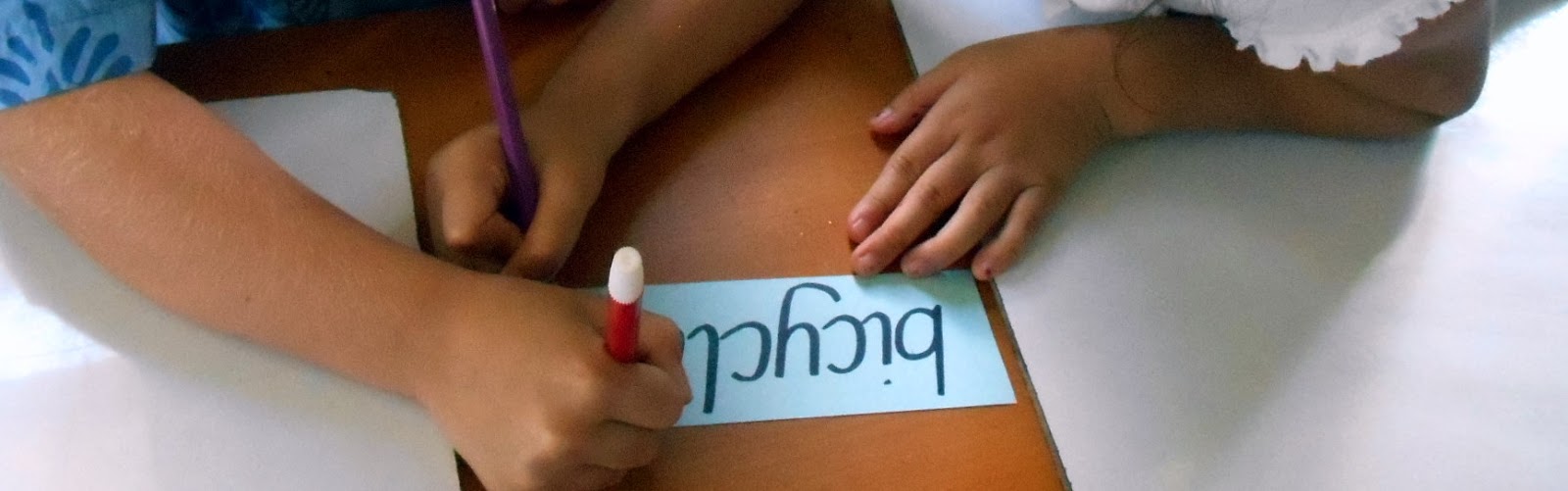
We scribe the children’s thoughts and plant important orthographic ‘learning seeds’ as we announce aloud the orthographic structures of bicycle and bike.
<bi + c-y-c-l-final non syllabic <e>> <b-i-k- final non syllabic <e>>
We talk about our collection of recycled materials to design, create and construct.
We talk about our collection of recycled materials to design, create and construct.

We ask the children to think about the meaning relationship between <cycles> and <recycled>.
Through these experiences we provide opportunities to build an understanding of the free base element <cycle>. We carefully note the children’s deepening understanding as they verbalise their ideas and thoughts and through conversations that occur in the learning environments. We especially note the changes that occur for the non-native English speakers and those that struggle with our language as they encounter new and unfamiliar lexicon.
Morphological Relatives
Cycles
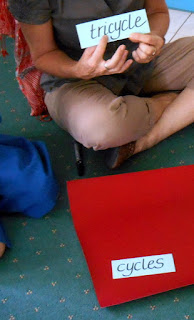


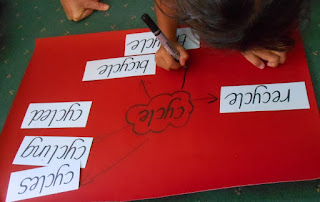
We begin to discover words that belong in the same family. As we extract words from the word bag the students hypothesize which words may be or may not be in a family. We announce aloud the structure of each word as it is revealed and discussed.
<cycle + s> <tri + cycle> <cycle + ing >


The children notice that the words all share a common base element. We hypothesize <cycle>.



The Etymological Story
Stories are made of words and every word has a story.
Cycle as a noun was attested in the late 14c. It is derived from Greek kyklos, ‘any circular body, circular motion, cycle of events’, indirectly via Late Latin cyclus,

ultimately able to be traced back 5,500 years to a Proto Indo European root *kwel-(1) "to revolve, move, round".
This ancient root has produced, amongst a myriad of other interesting connections, distant etymological relatives such as collar, colony, pulley and wheel.
Cycle as a verb was attested in 1842 carrying a meaning of ‘revolving in cycles’.
In 1883 specifically referring to riding a bicycle.(Etymology Dictionary)
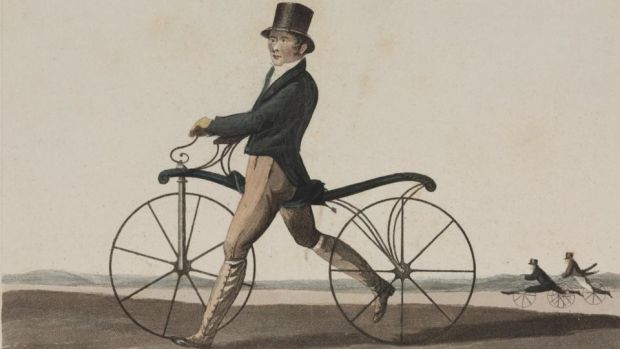
We use images to share the etymological journey of cycle with the children. We want them mostly to understand that it derives, indirectly, from Greek kyklos.
We ask:“What do you notice?”
The children ask about the spelling of <k> in the Greek word. We show how the word is spelled in Greek κύκλος. We talk about how a medial <y> in a base element is a reliable sign that the word has derived from Greek.
On another day we share the story of Cyclops, literally ‘round eyed’. The children have discovered the story in the library and of course they wish to know more.

How is it Built?
We return to the selection of words we have hypothesized sharing the free base element <cycle>. We model the assembly of the word sum, announcing aloud the written elements, pausing at the morphemic boundaries and announcing any suffixing changes. We find evidence of all the elements we have constructed.


As we begin to construct the matrix the children assemble the word sum on small white boards or in their word inquiry journals.
We write the word sum for each complex word before we add further elements to the matrix. We continually refer to the word-web to select words to place on the matrix.
We write the word sum for each complex word before we add further elements to the matrix. We continually refer to the word-web to select words to place on the matrix.


“c-y-c-l-final non syllabic e ... ing is rewritten as c-y-c-l-replace the e ... ing, cycle”.
The simultaneous actions of writing and announcing aloud ensures the internalization of all the elements.

We do this over a period of time, throughout the day, during the week focusing on one or two word sums at a time. The children take their matrix home to share with their family. We continue to explore the subtle differences between each word that share the free base element <cycle>.

The simultaneous actions of writing and announcing aloud ensures the internalization of all the elements.

We do this over a period of time, throughout the day, during the week focusing on one or two word sums at a time. The children take their matrix home to share with their family. We continue to explore the subtle differences between each word that share the free base element <cycle>.

The children choose to add to their matrix and build further words.
Simultaneously we continue our deep study of cycles in nature. We decide to focus on the cycle of day and night to appreciate and realise the motion of the earth orbiting the sun.


Phonology
With our knowledge of the morphology and etymology well embedded, we now embark on a study of the phonology of <cycle>, to investigate the significant graphemes and phonemes that bring further sense and meaning.
With our knowledge of the morphology and etymology well embedded, we now embark on a study of the phonology of <cycle>, to investigate the significant graphemes and phonemes that bring further sense and meaning.
We know that morphology and etymology drive phonology and therefore we can only investigate a word’s phonology within the domains of morphology and etymology.
The phonology of the free base element <cycle>:
4 graphemes <c> <y> <c> <l>
the single, final, non syllabic <e>
4 phonemes /s/ /aɪ/ /k/ /l/
As we hoped, the children are questioning and discussing the different functions of the single letter grapheme <c> in the initial and medial positions of <cycle>.
It is necessary for the children to understand:
- the same grapheme can and will represent different phonemes and
- the same phoneme can be represented by different graphemes.
The orthography of <c> provides the relevant learning opportunity to deepen these critical phonological principles. We study and analyse the single letter grapheme <c> which can represent two different phonemes /s/ and /k/.
The linguistic terminology: grapheme, phoneme, IPA, angle brackets and slash brackets naturally occur in our everyday discourse.
As with all our quests, we need to ensure the learning community understands the meaning of the words we will use to analyse phonologically.


Through this collaborative task the children encounter many words, building and deepening their personal lexicon. We deliberately partner ourselves with children who need support to understand their initial word. After this the children support each other.

The children collaboratively illustrate the words and return the words to the word bag.
During the next encounter the children select a word from the word bag and identify the position of the grapheme <c> in their word. We discuss the circumstances of this grapheme: initial, medial or final?
We guide the children through a concept attainment quest.
The children place their word on the Venn diagram as directed by us. Their role is to think about our thinking.

The children place their word on the Venn diagram as directed by us. Their role is to think about our thinking.

“Why did I ask you to place your word in the red circle or the blue circle or the overlapping part?”


“How interesting that cycle and circle are placed in the overlap!”
We revisit the phonological analysis over a number of days so the children have time to ponder on the placement of the words.
When we reconvene as a group the children discuss and share their hypotheses.
We decide as a learning community that the single letter grapheme <c> is representing either /s/ or /k/ or both in the case of circle and cycle.


During the next weeks we revisit the phonology of <c> so that the children develop their understanding of grapheme choices. We encourage the children to add other words to the growing collection as they encounter them in books or when writing.
We revisit the vowel letters and learn how to script the pathways of each letter. The children especially enjoy scripting the beautiful ligature of the vowel letter < y>.
We revisit the vowel letters and learn how to script the pathways of each letter. The children especially enjoy scripting the beautiful ligature of the vowel letter < y>.


We plant further phonological ‘learning seeds’ so the children will encounter other phonemes represented by the single letter grapheme <c>; or other graphemes that represent the phoneme /k/.

We are left with many questions as we continue our orthographic study.
Throughout our quest we read and revisit Jeannie Baker’s stunning literary text Circle.
 |
| "Tiny godwit birds follow ancient, invisible pathways in an infinity of sky. ‘Circle’ captures the sheer wonder of this migratory journey..." |
We wonder why the author has chosen the title Circle.
We feel and see the cyclic nature of the bar-tailed godwit’s annual journey in the text.
“Why not cycle?”
We wonder about cycle and circle.
“Are they etymologically related?”
We would like them to be related, but we know we need to provide evidence…


This study is an ebb and flow, a cycle, it’s cyclical, we are continually returning to our quest to deepen our learning and those of our students.
___________________________________________
To view the full article please click on this LINK. This will take you to Ann and Lyn's new Blog, Caught in the Spell of Words. Ann and Lyn are collaborating to demonstrate the power of studying orthography with the very young and our eldest students, explicitly embedded in the realms of meaningful and inspirational learning contexts.

___________________________________________
To view the full article please click on this LINK. This will take you to Ann and Lyn's new Blog, Caught in the Spell of Words. Ann and Lyn are collaborating to demonstrate the power of studying orthography with the very young and our eldest students, explicitly embedded in the realms of meaningful and inspirational learning contexts.
Caught in the Spell of Words
stories are made of words and words are made of morphemes


