Showing posts sorted by date for query key. Sort by relevance Show all posts

Friday, 11 December 2020

FIELD GUIDE TO WORDS

A Field Guide to Words:                    Enlightening, Eclectic, Entertaining

With lavender and poppies abounding in our garden it's time to come out and PLAY after the restrictions of winter and the pandemic, to delight in the extraordinary, the hidden stories, the wonders of a word’s past and present. 


These Field Guides are the ideal companion for teachers and logophiles. 

The writers, two educators, share their passion for orthographic linguistics to celebrate the sense and order of English orthography.

With these guides in your hand, you and your students will be inspired to investigate and marvel at the richness of the English language. 


Lyn & Ann's latest Field Guide to Words: PLAY highlights:


- the written orthographic statement with teacher dialogue 


- Chancery script as the foundation for all orthographic study


- an annotated matrix 


- how to read an etymology entry


- compounds


- a key phonological investigation.


A Field Guide to Words goes beyond and beneath the surface to uncover the unity and interrelationship of the 3 components of orthography: morphology, etymology and phonology.


A reissue of SERIES 1 (a set of 4 booklets) is now available:


Cycles

Transformation & Metamorphosis 

Adaptation

Play


Please head to the FIELD GUIDE STORE to purchase.


Tuesday, 16 September 2014

friend...real connections, real stories

Real Connections: MEANING, STRUCTURE, RELATIVES, PRONUNCIATION
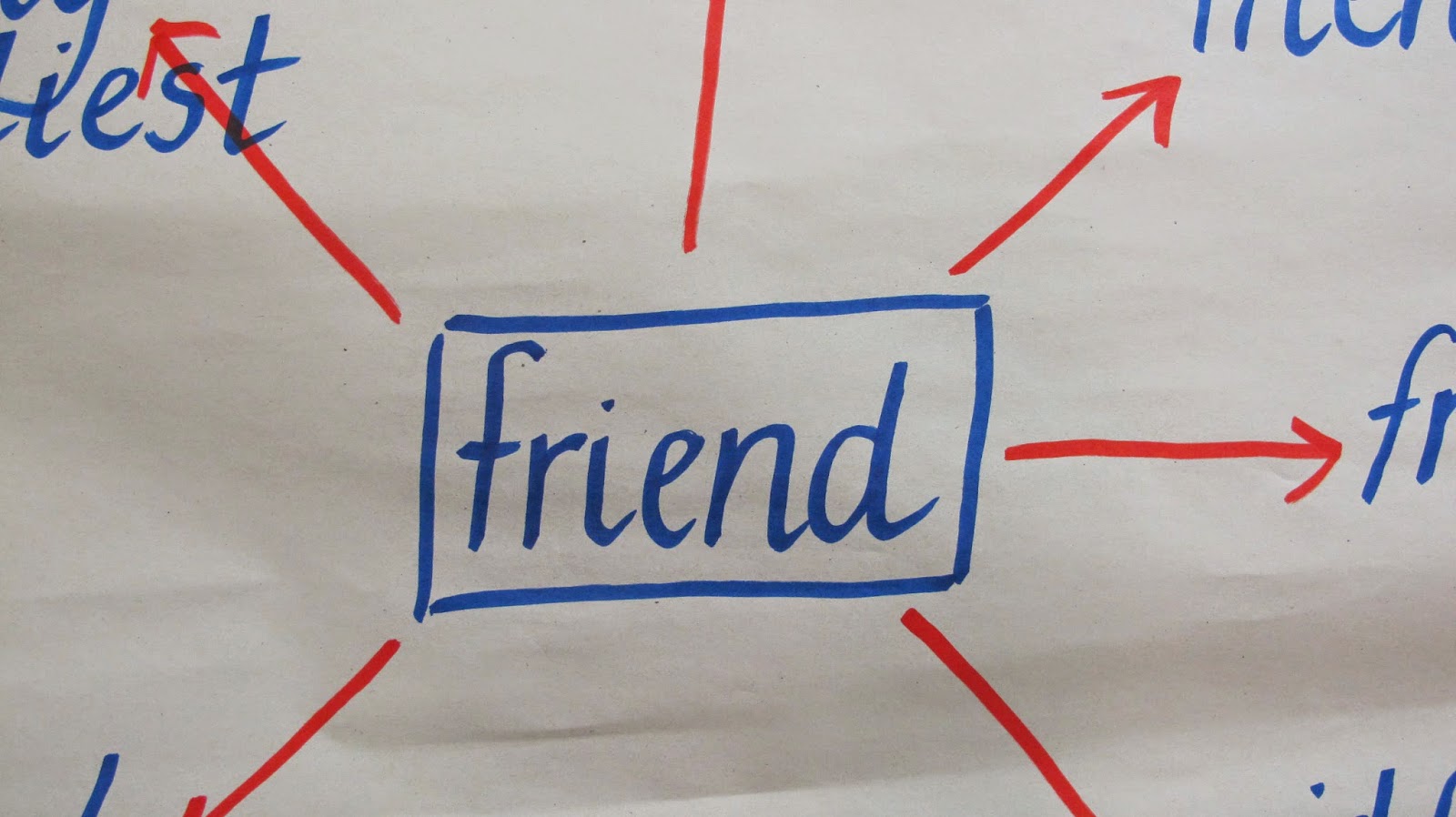
<friend> 
... such a valuable and interesting word to investigate at the beginning of the school year...
I love that this word has a non-phonemic letter to demonstrate that not all letters in an English word will represent pronunciation. 

I love that this word explicitly demonstrates that the primary function of English spelling is to represent MEANING, not pronunciation.

I have been working with a group of young students whose previous spelling instruction has primarily been based on thinking that spelling represents sound.

"Time to change their thinking by explicitly demonstrating and investigating 
how the English spelling system really works."

I want the children to be able to spell <friend> accurately from the very beginning of the school year but  more importantly I want them to know why it is spelled this way; I want them to understand that not all letters in a word are there to represent pronunciation; I want them to know that some letters are etymological markers which give us important clues about the spelling. I want the children to be on a learning journey of discovery and understanding...

How did I choose <friend> for investigation?
This was a central word as part of the initial discussion and development of the class essential learning agreements early in the school year, in conjunction with many others like: <respect> <safety> <collaboration>. All ripe for future word investigation and inquiry!

From the beginning of the school year the children were consistently challenged to think about the how and why of words. We constructed many word families using words from the first PYP Unit of Inquiry. They were introduced to important terminology; base, suffix, prefix, meaning, structure.
After only one month the children are already  beginning  to analyse/synthesise words based on this growing understanding.

Setting the scene
We presented two questions:
 I deliberately used the terminology 'word' not 'base' in this
question so that the children would consider another
possible base.
Initially I chose to present <friend> as
the base but  I also presented this question
to provoke and challenge the children's thinking.
I wanted to see if anyone would
 hypothesise <fri> as a possible base.

1. What does it mean? Predictably the children discussed the idea of 'friendship' connected to their personal experiences.
2. What is the structure of the word? The majority of the children hypothesised  <friend> as the base. Predictably one child presented <fri> (as in <fry>)  which led to an important discussion about meaning and how <fry> has no meaning connection to <friend>. 

Consistently, I observe children needing this fundamental concept to be revisited over and over again to help them fully understand the importance of both meaning and structure as the key to the connection.
3. What are its relatives?
The first activity was a think/pair/share. Individually, the children wrote one or two (or more) words related to the word <friend> on a piece of paper. This was an initial assessment piece to ascertain the children's present understanding of how words are related in meaning and structure. The children then collected further words, to add to their original list, by sharing with each other. They moved from partner to partner until they had collected an extended list. It was incredibly exciting to watch the children actively discussing and trading each other's words. 
The children are writing a collection of words
related to <friend>

The children shared their hypotheses with each other and
added to or modified  their own list of  words.
I had the absolute joy of overhearing one student tell another student (who offered <fri> and <end> as  two related words) that they couldn't belong in the family of <friend> "because they didn't have the same meaning or the same spelling."  He then proceeded to give the other student clear evidence by providing his three words (friendly, friends and befriended) to demonstrate what he meant. No need for adult intervention here...Max had certainly provided the necessary teaching. I shared this observation later  as we revisited the fundamental concept of  how words are related in meaning and structure.

Can you see how valuable this initial activity is in terms of assessing children's understanding throughout the learning process? 
The other valuable part of this activity is the expectation that all children will actively participate, regardless of where they are on their learning pathway; and the opportunity to learn from each other, as demonstrated above, cannot be underestimated. 
A student is extending her list of
related words by trading with her
classmates.

As a whole group, we shared and recorded the words on a word web. I explicitly stated, every time, how the words were related in meaning and structure; and how new words were constructed. 

What did you do to construct this word <friendly>? 
...consistently asking the students to clarify and provide evidence...
How do you know <-ly> is a suffix?

The word bag!
A student, who currently speaks very little English, had the job of extracting words from a word bag, to check if there were others we could add to the current word web. I placed two words for provocation  in the bag: <fried> and <Friday>.  The children suggested that both <fried> and <Friday> couldn't belong in this word family because they didn't have the same meaning. We decided to leave these words off the word web until we had provided some evidence. You will notice that even though I knew, as a teacher, that <Friday> was related, that I didn't share this information at this particular time on their learning journey. My goal was to guide them to their own understanding of this relationship.

However, I did ask the question "I wonder what Friday means?" to challenge their thinking and hopefully jog their previous learning about the days of the week. One student suggested that Friday was named after Frigga! "I know her!" counteracted many of the other children.

An Etymological Study!
As I told the historical 'story" I wrote key words,
pictures and connecting arrows to demonstrate
the 'big picture'.
The children also recorded the story
on individual whiteboards.
The following day I related the historical 'story' of 'friend' by linking the word to 'Friday' and 'Frigga'.  
We studied images of the Romans and the Germanic peoples, explaining how the days of the week evolved through history. The children could clearly see the connection between Friday and Frigga.

I modelled how to use the Word Origin Dictionary to discover further important historical information about 'friend'. For many this was new.
<friend> was written on a post-it note to indicate where in the dictionary it was located. A child was selected to open to the page and locate the word <friend>. 
I summarised the relevant information highlighting the diachronic meaning; 'loving' Old English 'freond'; Proto Germanic 'frijand'.
The children were now able to ascertain a clearer connection with 'Friday' and 'Frigga'. 
The <i> is present to show its meaning connection to <Friday> and historical connection to 'Frigga', the Germanic Goddess of love.
The children are recording the history
of <friend> as we discuss it together.
Of course this is not the full etymological story of the word <friend>. You can trace its history way back from the PIE root 'pri' meaning 'to love'. One student has recently discovered that <free> is related too!

A closer investigation of the structure of words and the 'spelling out' strategy
In subsequent lessons we investigated the structure of each of the words from the word web. Beginning with a blank matrix we gradually added the appropriate affixes to construct new words. 
I explicitly modelled the construction of the word sum, demonstrating the 'spelling out' strategy, critical for internalisation. The children practised constructing the word sums on individual whiteboards.
                                   
I briefly introduced how to identify and check for any changes.  "Stop, check for changes, change the y to an i" as in this word structure: <friend> + < ly/i> + <er> --> friendlier
For now, I only needed the children to understand that there might be a change caused by a suffix. Investigation                                                                        of the <i/y> suffixing convention would happen in the                                                                            future.


During the next few days we constructed additional words, writing the word sum to demonstrate the underlying structures. You may notice that the matrix is not completed and it won't be for sometime. This 'work in progress' is an indication of the children's learning journey; an understanding that we could add, change, modify the matrix and word web as our learning deepens. 
More information is gradually
added to the matrix as we revisit
meaning, structure, history
and connections.
Throughout the process one student consistently wanted to know how could we add <Friday> to the matrix. He had developed a hypothesis that <fri> was the base, based on the structure of <Friday> Fri + day --> Friday
I had this blank matrix ready to demonstrate his hypothesis. We will revisit this matrix and discuss how it could be constructed at another time. It is there for provocation, thought and discussion. 

Time to consolidate
The following week the children  independently constructed word sums from a variety of matrices.  
I can assure you by this stage all the children are spelling <friend> accurately and they know why there is an <i>! 
You will notice that the matrices are different, varying in complexity. At times I choose the matrices for the children, other times they choose. One student added to the complexity of his matrix, demonstrating his own deep understanding of the underlying structures of words.  
The children chose words to write in sentences or illustrate to show the meaning; they constructed words at home to teach their families.
 

We have been revisiting the structure of words by constructing large word sums to identify the morphemes and graphemes in the base and the underlying changes.
In this session the children had one piece of the word sum, on a large piece of card.
Together they had to sequence themselves to form the final word sum. Collaboration in action.
This beats memorising a list of unrelated words!
What about pronunciation?
Throughout the whole learning process the children were introduced to 'tasting and feeling' phonemes. We have started to look more carefully at what is happening in our mouth and throat as we sequence the important phonemes in a word. 

Learning is a journey; a journey of discovery and connections...and so our journey continues!

You can go to Real Spelling, Toolkit2 Kit2 ThemeL Naming the Days of the Week, for the full story of <friend>.

and Pete Bowers Word Works Spelling Out Word Structure
Give me a shout! 
If you happen to be using my blog please drop me a line and let me know what you think, 
what you would like to see, what you enjoyed! 

Thursday, 26 September 2013

Opening up the mystery box!


Investigating the underlying structure of words through the analogy of 'opening up a mystery box'.

This activity introduces an important linguistic feature, which demonstrates that words have many layers (substructure) that need to be uncovered to reveal the reason for the spelling. Only through careful investigation of these 'hidden' layers can we begin to fully understand why and how words are spelled the way they are.
These grade 2/3 students are investigating the underlying structure of words using the analogy of a mystery box. This activity was specifically planned to introduce the concept that words have a linguistic structure that is not at first 'visible'. These students did not have any previous knowledge of how the English spelling system really works.

Our investigative question: 
Why is <hoping> spelled with one <p> 
but <hopping> spelled with double <pp>? 

The answer lies in the MEANING...this may, at first, seem like a simple question but only when you 'peel away' the layers of these two words, through careful investigation and critical thinking, can you fully understand the two different spellings. 

 Introduction: A closed mystery box was revealed to the students. Inside were some special treasures. An element of one of the treasures (in this case, a piece of red ribbon) was visible on the outside of the box. Based on their observations, the students discussed, predicted and shared theories about what could be in the mystery box. When opened, the full treasure was revealed (a small round stone encased in a red bag with a red ribbon).


Just like the scenario of the mystery box, English spelling is similar! You have to 'open up' the words to reveal the underlying meaning and structure of the words...that contains the base, the meaning of the word and ultimately the spelling of the word.


"Let's investigate this word <hoping> ... what is hidden inside?" 

Just like the hidden treasure, with only a small part visible, the word <hoping> was written on a card and placed on the outside of the box. 

Is this word related to <hope> or <hop> the children are wondering? 
Why is there only one <p>? 
If it is <hoping> what has happened to the final <e>? 
These were just some of the questions the students were asking, discussing and wondering. 

Each student made predictions, based on their previous knowledge and own understanding. This informal discussion provided valuable information and ongoing assessment for the teacher. 
Just like opening up the box to reveal the treasure, the parts of the morphological word sum were revealed when the box was opened:
  • the base <hope/> indicating the suffixing change for the final, single, silent <e>
  • the suffix <-ing> 
  • the 'rewritten as' arrow ---->
  • and the + signs
The students worked together to sequence the word sum from left to right. By building the word sum the students were able to ascertain that the word was <hoping> not <hopping> based on the understanding that the base <hope> holds the meaning.
 Revealing the word treasure: 
hope/ + ing --> h-o-p-(no e)-ing
(announce the parts as you simultaneously write them)

This activity demonstrates the importance of:
  • identifying the underlying structure; the base and the affixes;
  • understanding the meaning of the base;
  • identifying any suffixing changes that are not visible in the final word.

The 'hidden treasure' or underlying structure is the KEY to the final spelling.
As a follow up activity, the students created a word family for the base <hope> and are discovering and adding more words using dictionaries.
Building a large, suffix flowchart will help develop understanding of why the
final, single, silent <e> is removed when a vowel suffix is removed.

Please contact me through the comments section or through this link if you would like to continue a conversation about structured word inquiry in the early years. 

Saturday, 17 August 2013

Starting the learning journey...word families, word webs, matrixes, word sums


Essential Understandings...where to start?

Building essential orthographic understanding in the
early years.
"What are some ways to start teaching structured word inquiry 
with a group of children...?"
A frequently asked question from teachers who are embarking on the critical journey of teaching orthography (morphology, etymology and phonology).

I use the word <critical> with great emphasis, as I believe orthography, and in particular morphology (and etymology), to be the critical 'missing link' in the teaching of literacy in the early years of schooling.
Using significant words to investigate,
from a Unit of Inquiry about materials and their properties.
Although I am particularly interested in provided developmentally appropriate experiences for younger children, the following strategies and activities have been presented to different age groups, ranging from 3 year olds to Middle School students to adults. 
Learning to use resources to independently investigate the
structure, meaning and history of words.
As with all our teaching and learning, the learners' prior knowledge, understanding, age and learning needs are taken into careful consideration to plan the most appropriate and relevant experiences. Consequently these activities are consistently adapted according to the needs of the learner group.
Using significant learning tools like flowcharts, to build understanding of
essential suffixing  patterns.

Here is an example of a structured learning experience to introduce the essential understandings of English orthography.


Starter word: <healthy>

Structured Word Inquiry: A selection of learning experiences
(from 'Starting the Learning Journey' document)
1. Developing a bank of word webs, using free starter bases, to demonstrate the significance of the connectedness of meaning and spelling. 
For example (heal) is the base of (healthy), and is clearly related in meaning, even though there is a pronunciation change in the word (healthy). The spelling comes directly from the base <heal>, hence:
 heal + th + y --> healthy
A 'work in progress' word web created by a Grade 1/2 group to demonstrate the
word family for the base <heal>.

These structured word inquiry activities, such as building word webs, can be effectively embedded in your current Unit of Inquiry. For example, this group of students were investigating the following central idea for this PYP Unit of Inquiry about the human body.
(healthy) was a significant word used throughout the unit.

The students created a base 'pot' to demonstrate
the significance of the base and to teach the
difference between the meaning and spelling of
<heal> , <heel> and <hill>, which have
similar pronunciations.

...and a suffix pot too!

The students are creating morphological word sums for the
base <heal>.
The students created the word sum for <unhealthier>.
un + heal + th + i/y +er --> unhealthier
The word web for (heal), and other related activities, can be shared at an assembly or with other audiences.
The base (heal) jumped out of the base pot!
The students demonstrated the word sum for (healthy), with the base (heal) and the two suffixes (th) and (y), demonstrating the suffix change of the i/y.

These initial, introductory activities help to build a solid foundation for future learning and further exploration. For example, as a teacher you might now decide to:
  • demonstrate how the words can be arranged in the form of a matrix. 
  • write and spell the word sums.
  • focus on the suffixing pattern of i/y.
  • investigate homophones (heal) (heel).
  • investigate the different phonemes for the diagraph (ea) in (heal) and (health).  
  • do a further investigation of the etymology of (heal), looking for etymological markers as a key to the spelling.
Real Spelling has posted a very valuable video in the comments section of this post. This video gives the full story of the free base <heal>. With this information and understanding you, as the teacher, can now make better informed choices about what elements to introduce, teach and guide your students. 
As Pete Bower's states "How can we offer learners an understanding of our writing system unless the instruction is informed by an
accurate understanding in the first place?"

As indicated in the learning experience above, you can begin with a starter base already known by the students, with a prepared bank of words,  OR you can...

...start with a group of words (in a bag, pocket or mystery box) with a starter base to be discovered by the students!


starter base <paint>
Start with a bag of words and a blank word web.
In this activity the words are
<painted> <painting> <painter> <repaint>...
The children predict the base as the words are exposed, discussed
and placed on the word web.
As each word is exposed the students discuss the meaning of the word and think about the base.
The students actively participate in the learning.

When all the words have been added to the word web the students are 
asked to make a prediction about the base. Ask the students to share their ideas with a partner.
When the base has been revealed and proven it can be
 recorded on the word web.
And finally illustrated and presented by the students. The students can now create their own word web.
The completed (or maybe, not completed!) word web. 

You can find more information about these learning experiences by clicking on these links: word web collaborative activity; blog post 'Can you teach morphology to Young Children?'; article Starting the Learning Journey