Real Connections: MEANING, STRUCTURE, RELATIVES, PRONUNCIATION
<friend>
... such a valuable and interesting word to investigate at the beginning of the school year...
I love that this word has a non-phonemic letter to demonstrate that not all letters in an English word will represent pronunciation.
I love that this word explicitly demonstrates that the primary function of English spelling is to represent MEANING, not pronunciation.
I have been working with a group of young students whose previous spelling instruction has primarily been based on thinking that spelling represents sound.
"Time to change their thinking by explicitly demonstrating and investigating
how the English spelling system really works."
I want the children to be able to spell <friend> accurately from the very beginning of the school year but more importantly I want them to know why it is spelled this way; I want them to understand that not all letters in a word are there to represent pronunciation; I want them to know that some letters are etymological markers which give us important clues about the spelling. I want the children to be on a learning journey of discovery and understanding...
How did I choose <friend> for investigation?
This was a central word as part of the initial discussion and development of the class essential learning agreements early in the school year, in conjunction with many others like: <respect> <safety> <collaboration>. All ripe for future word investigation and inquiry!
From the beginning of the school year the children were consistently challenged to think about the how and why of words. We constructed many word families using words from the first PYP Unit of Inquiry. They were introduced to important terminology; base, suffix, prefix, meaning, structure.
After only one month the children are already beginning to analyse/synthesise words based on this growing understanding.
Setting the scene
We presented two questions:
 |
I deliberately used the terminology 'word' not 'base' in this
question so that the children would consider another
possible base. |
 |
Initially I chose to present <friend> as
the base but I also presented this question
to provoke and challenge the children's thinking.
I wanted to see if anyone would
hypothesise <fri> as a possible base. |
1. What does it mean? Predictably the children discussed the idea of 'friendship' connected to their personal experiences.
2. What is the structure of the word? The majority of the children hypothesised <friend> as the base. Predictably one child presented <fri> (as in <fry>) which led to an important discussion about meaning and how <fry> has no meaning connection to <friend>.
Consistently, I observe children needing this fundamental concept to be revisited over and over again to help them fully understand the importance of both meaning and structure as the key to the connection.
3. What are its relatives?
The first activity was a think/pair/share. Individually, the children wrote one or two (or more) words related to the word <friend> on a piece of paper. This was an initial assessment piece to ascertain the children's present understanding of how words are related in meaning and structure. The children then collected further words, to add to their original list, by sharing with each other. They moved from partner to partner until they had collected an extended list. It was incredibly exciting to watch the children actively discussing and trading each other's words.
 |
The children are writing a collection of words
related to <friend> |
 |
The children shared their hypotheses with each other and
added to or modified their own list of words. |
I had the absolute joy of overhearing one student tell another student (who offered <fri> and <end> as two related words) that they couldn't belong in the family of <friend> "because they didn't have the same meaning or the same spelling." He then proceeded to give the other student clear evidence by providing his three words (friendly, friends and befriended) to demonstrate what he meant. No need for adult intervention here...Max had certainly provided the necessary teaching. I shared this observation later as we revisited the fundamental concept of how words are related in meaning and structure.
Can you see how valuable this initial activity is in terms of assessing children's understanding throughout the learning process?
The other valuable part of this activity is the expectation that all children will actively participate, regardless of where they are on their learning pathway; and the opportunity to learn from each other, as demonstrated above, cannot be underestimated.
 |
A student is extending her list of
related words by trading with her
classmates. |
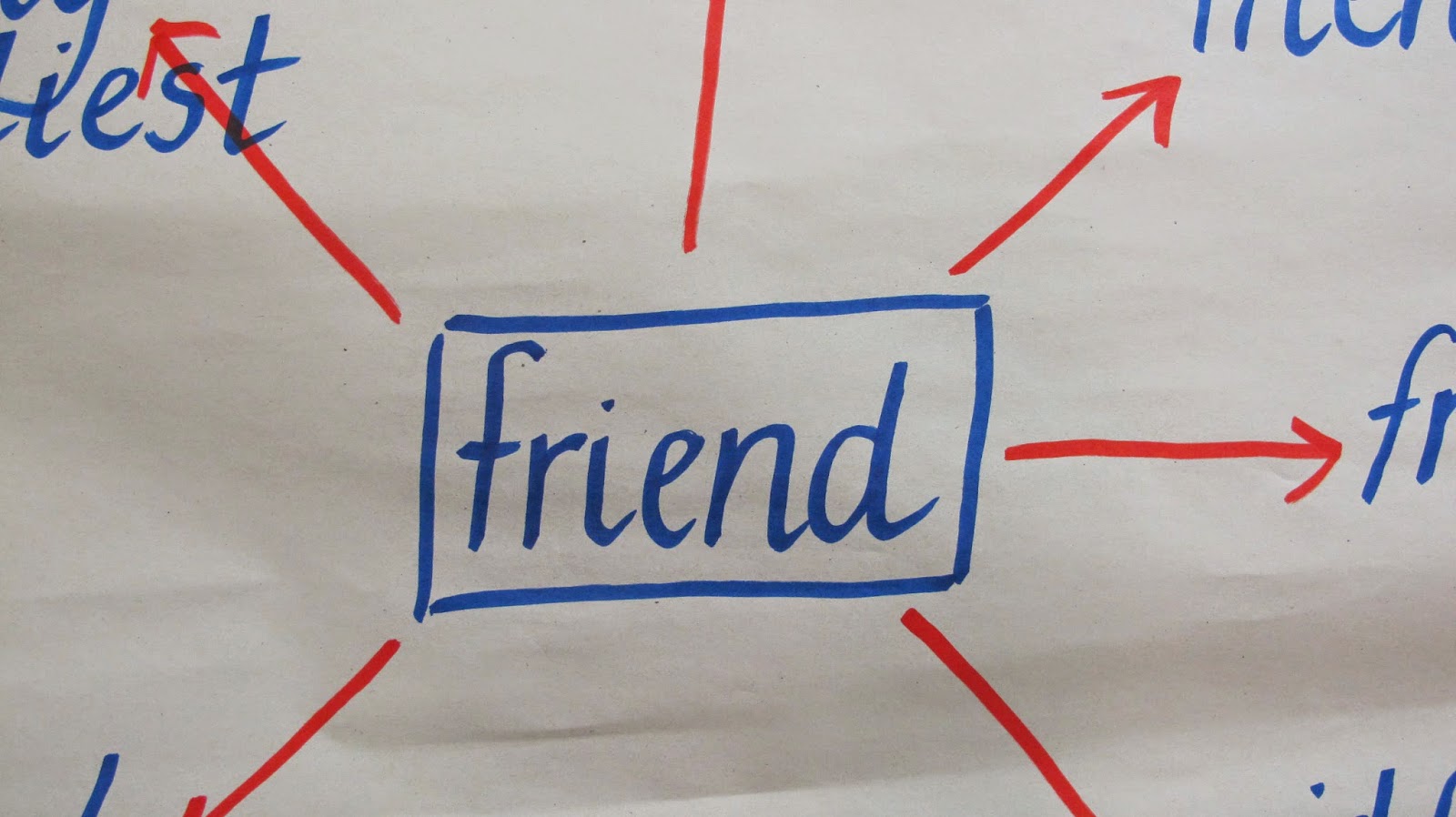
As a whole group, we shared and recorded the words on a word web. I explicitly stated, every time, how the words were related in meaning and structure; and how new words were constructed.
What did you do to construct this word <friendly>?
...consistently asking the students to clarify and provide evidence...
How do you know <-ly> is a suffix?
 |
| The word bag! |
A student, who currently speaks very little English, had the job of extracting words from a word bag, to check if there were others we could add to the current word web. I placed two words for
provocation in the bag: <fried> and <Friday>. The children suggested that both <fried> and <Friday> couldn't belong in this word family because they didn't have the same meaning. We decided to leave these words off the word web until we had provided some evidence. You will notice that even though I knew, as a teacher, that <Friday> was related, that I didn't share this information at this particular time on their learning journey. My goal was to guide them to their own understanding of this relationship.
However, I did ask the question "I wonder what Friday means?" to challenge their thinking and hopefully jog their previous learning about the days of the week. One student suggested that Friday was named after Frigga! "I know her!" counteracted many of the other children.
An Etymological Study!
 |
As I told the historical 'story" I wrote key words,
pictures and connecting arrows to demonstrate
the 'big picture'.
The children also recorded the story
on individual whiteboards. |
The following day I related the historical 'story' of 'friend' by linking the word to 'Friday' and 'Frigga'.
We studied images of the Romans and the Germanic peoples, explaining how the days of the week evolved through history. The children could clearly see the connection between Friday and Frigga.
I modelled how to use the Word Origin Dictionary to discover further important historical information about 'friend'. For many this was new.
<friend> was written on a post-it note to indicate where in the dictionary it was located. A child was selected to open to the page and locate the word <friend>.
I summarised the relevant information highlighting the diachronic meaning; 'loving' Old English 'freond'; Proto Germanic 'frijand'.
The children were now able to ascertain a clearer connection with 'Friday' and 'Frigga'.
The <i> is present to show its meaning connection to <Friday> and historical connection to 'Frigga', the Germanic Goddess of love.
 |
The children are recording the history
of <friend> as we discuss it together. |
Of course this is not the full etymological story of the word <friend>. You can trace its history way back from the
PIE root 'pri' meaning 'to love'. One student has recently discovered that <free> is related too!
A closer investigation of the structure of words and the 'spelling out' strategy
In subsequent lessons we investigated the structure of each of the words from the word web. Beginning with a blank matrix we gradually added the appropriate affixes to construct new words.
I explicitly modelled the construction of the word sum, demonstrating the 'spelling out' strategy, critical for internalisation. The children practised constructing the word sums on individual whiteboards.


I briefly introduced how to identify and check for any changes. "Stop, check for changes, change the y to an i" as in this word structure: <friend> + < ly/i> + <er> --> friendlier
For now, I only needed the children to understand that there might be a change caused by a suffix. Investigation of the <i/y> suffixing convention would happen in the future.


During the next few days we constructed additional words, writing the word sum to demonstrate the underlying structures. You may notice that the matrix is not completed and it won't be for sometime. This 'work in progress' is an indication of the children's learning journey; an understanding that we could add, change, modify the matrix and word web as our learning deepens.
 |
More information is gradually
added to the matrix as we revisit
meaning, structure, history
and connections. |
Throughout the process one student consistently wanted to know how could we add <Friday> to the matrix. He had developed a hypothesis that <fri> was the base, based on the structure of <Friday> Fri + day --> Friday
I had this blank matrix ready to demonstrate his hypothesis. We will revisit this matrix and discuss how it could be constructed at another time. It is there for provocation, thought and discussion.
Time to consolidate
The following week the children independently constructed word sums from a variety of matrices.
I can assure you by this stage all the children are spelling <friend> accurately and they know why there is an <i>!
You will notice that the matrices are different, varying in complexity. At times I choose the matrices for the children, other times they choose. One student added to the complexity of his matrix, demonstrating his own deep understanding of the underlying structures of words.
The children chose words to write in sentences or illustrate to show the meaning; they constructed words at home to teach their families.


We have been revisiting the structure of words by constructing large word sums to identify the morphemes and graphemes in the base and the underlying changes.
 |
In this session the children had one piece of the word sum, on a large piece of card.
Together they had to sequence themselves to form the final word sum. Collaboration in action.
This beats memorising a list of unrelated words! |
What about pronunciation?
Throughout the whole learning process the children were introduced to 'tasting and feeling' phonemes. We have started to look more carefully at what is happening in our mouth and throat as we sequence the important phonemes in a word.
 Learning is a journey; a journey of discovery and connections...and so our journey continues!
You can go to
Real Spelling,
Toolkit2 Kit2 ThemeL Naming the Days of the Week, for the full story of <friend>.
and
Pete Bowers Word Works Spelling Out Word Structure
Give me a shout!
If you happen to be using my blog please drop me a line and let me know what you think,
what you would like to see, what you enjoyed!


 Return together as a group and whisper statement to self. Hide "key' in pocket for later reference.


 Initially the learning is purely kinaesthetic and oral. For this reason I don't recommend directly writing the vowel letters on the fingers (with marker or pen) but model the correct formation of each vowel letter on the palm of the hand with the pointer finger. Learners can then practise the formation of the letters on small whiteboards or with pen and paper, as indicated in these photos.


